




Price:
(as of Jul 26, 2026 21:24:07 UTC – Details)

KODAK PIXPRO C1 Review: A Pocket-Sized Portal to Retro Aesthetics and Modern Convenience
In an era dominated by computational photography and multi-lens smartphone arrays, there remains a distinct, growing niche for dedicated digital cameras that prioritize tactility, intentionality, and a specific aesthetic. The KODAK PIXPRO C1 arrives squarely in this sweet spot, positioning itself not as a technical powerhouse designed to rival full-frame mirrorless systems, but as a lifestyle accessory—a “digicam” built for the social media generation, the travel minimalist, and the nostalgia enthusiast. With its 13MP BSI CMOS sensor, bright f/2.0 fixed 26mm lens, and a defining 180-degree flip screen, the C1 promises a streamlined shooting experience that bridges the gap between vintage charm and contemporary connectivity. After spending time evaluating its specifications and feature set, it is clear that the C1 is a highly targeted device: one that succeeds brilliantly at its specific mission while making calculated compromises elsewhere.
Design and Ergonomics: Retro Soul, Modern Build
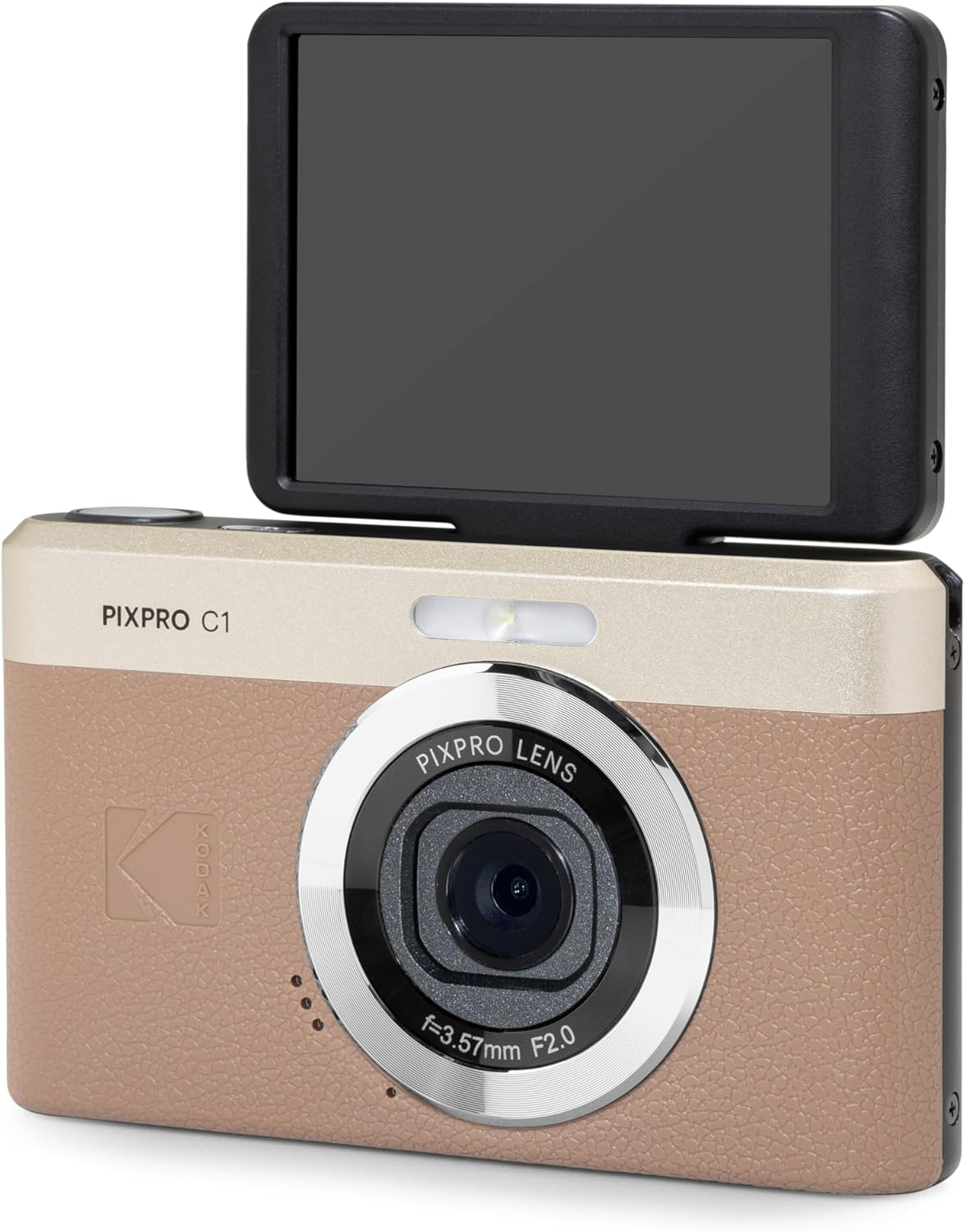
The first interaction with the PIXPRO C1 is visual and tactile. Kodak has leaned heavily into the “vintage vintage design” mentioned in the spec sheet, and the result is a camera that looks like it fell out of a time capsule from the late 1990s or early 2000s—specifically in the provided Brown colorway, which exudes a warm, leatherette sophistication often reserved for premium compact cameras costing three times the price.
Physically, the C1 is diminutive. It is a true shirt-pocket camera, the kind that disappears into a small crossbody bag or a jacket pocket without creating a bulge. The fixed lens design is central to this portability; there is no extending barrel to worry about, no motor whirring to life on startup, and no risk of dust entering a zoom mechanism. The control layout is refreshingly sparse. A mode dial, shutter button, zoom rocker (controlling the 4x digital zoom), and a four-way directional pad dominate the top plate and rear. There are no custom function buttons, no complex menu diving wheels, and no touchscreen. This is a deliberate choice. For the target demographic—beginners, teens, and content creators wanting a “pick up and shoot” experience—this lack of friction is a feature, not a bug. It forces the user to engage with the moment rather than the settings menu.
The build quality feels solid for the class. It doesn’t have the dense, cold magnesium alloy heft of a professional body, but the plastic chassis feels reassuringly dense, and the brown textured grip area provides sufficient purchase for one-handed selfie operation.
The Defining Feature: The 180-Degree Flip Screen
If there is a single spec that justifies the C1’s existence in a crowded market, it is the 2.8-inch LCD screen that tilts a full 180 degrees upward.
In the current landscape of “digicam revival,” many popular vintage models (like the Fujifilm X100 series or older Canon PowerShots) lack front-facing screens, making solo vlogging or precise self-portraiture a game of guesswork. The C1 solves this natively. The hinge mechanism feels robust, clicking confidently into the fully forward position. When flipped, the screen sits flush against the top of the camera body, allowing the lens to point directly at the subject while the user maintains perfect eye contact with the display.
For vloggers, this is transformative. It enables walk-and-talk segments, product showcases, and “get ready with me” videos without requiring an external monitor or a mirror hack. For group shots, it eliminates the “arm stretch” guesswork. The 2.8-inch size is adequate for framing and menu navigation, though it is worth noting that in bright, direct sunlight, the screen’s visibility can be challenged—a common limitation for cameras in this price bracket lacking high-nit panels or electronic viewfinders. However, for the intended use case (indoor content creation, golden hour travel, cafe hopping), it performs admirably.
Optical Performance: The 26mm f/2.0 Fixed Prime
The heart of the C1’s imaging pipeline is its lens: a fixed focal length 26mm (full-frame equivalent) with a maximum aperture of f/2.0. This is a bold specification for a budget compact. Most cameras in this tier ship with slow variable-aperture zoom lenses (typically f/3.5-f/6.3). By fixing the focal length, Kodak has engineered a “fast” prime lens into a tiny body.
The 26mm focal length is a classic “wide normal.” It is wider than the standard 28mm or 35mm found on many phones, making it exceptional for environmental portraits, tight interior architecture, street scenes, and the quintessential “table-top” food or coffee shot. It encourages the photographer to “zoom with their feet,” a fundamental compositional discipline.
The f/2.0 aperture is the star of the low-light show. It gathers significantly more light than a standard kit zoom, allowing for lower ISO values in dim restaurants, bars, or golden hour cityscapes. This translates directly to cleaner images with less noise reduction artifacting—critical for a 13MP sensor. The background separation (bokeh) at f/2.0 is pleasant for a sensor of this size; while it won’t replicate the “full-frame look,” it offers enough subject separation to make portraits pop against busy backgrounds.
The spec sheet notes a 4x digital zoom. It is crucial to distinguish this from optical zoom. Digital zoom crops into the sensor’s 13MP resolution. At 2x, you are effectively using a ~3.25MP center crop (roughly 4K resolution). At 4x, you are down to sub-megapixel territory. For social media web resolution (typically 2MP-4MP), a moderate 1.5x-2x digital crop is perfectly usable. Beyond that, image degradation becomes apparent. The inclusion of digital zoom provides flexibility, but the optical sweet spot remains firmly at the native 26mm.
Image Quality: The 13MP BSI CMOS Sensor
The 13-megapixel Back-Side Illuminated (BSI) CMOS sensor is a known quantity in the industry, often found in action cameras and mid-range smartphones from a few generations ago. BSI architecture improves light gathering by moving the wiring behind the photodiodes, a tangible benefit for a small 1/2.3″ or 1/3″ sensor format.
In good light—outdoor daylight, bright overcast, well-lit interiors—the C1 produces images that are surprisingly pleasing. The 13MP resolution is the “Goldilocks” zone for this form factor: large enough to allow for significant cropping or large prints (up to 11×14 inches easily), but small enough to keep file sizes manageable and buffer speeds snappy. Colors carry that distinct Kodak science—warm skin tones, punchy blues and greens, and a generally “film-like” rendering that requires zero post-processing for Instagram or TikTok uploads.
Dynamic range is the expected limitation. High-contrast scenes (backlit subjects against bright skies) will blow highlights or crush shadows. The camera handles this via automatic scene modes (likely HDR backlight compensation), but the user has no manual control over dynamic range optimization or RAW capture. This is a JPEG-only workflow. For the target user, this is a benefit: the camera bakes in the “look,” delivering a finished file instantly.
Low light performance is respectable for the category, largely thanks to that f/2.0 lens. At ISO 400-800, images remain clean. Pushing to ISO 1600-3200 introduces noticeable luminance and chroma noise, and the camera’s noise reduction begins to smear fine detail into a “watercolor” effect. However, because the lens stays at f/2.0, you rarely need to push ISO as high as you would on an f/5.6 zoom compact. It is a symbiotic relationship between sensor and glass.
Video Capabilities: 1080p Full HD in a 4K World
The specification lists “1080p Full HD Video.” In 2024, the absence of 4K recording is the most glaring omission on the spec sheet. However, context is king. The C1 uses a 13MP sensor; reading out 4K (8MP) at 30fps with full sensor readout requires processing horsepower and heat dissipation that likely exceeds the budget and thermal envelope of this chassis.
For the intended output—vertical video for Reels, Shorts, and TikTok—1080p is currently the native delivery resolution for most platforms. Shooting 1080p natively means smaller file sizes, faster offload times via USB-C, and less strain on the microSD card write speeds. The footage exhibits the same pleasant color science as the stills. The fixed 26mm lens is arguably better for vlogging than a tight 24mm or 20mm equivalent; it provides a natural field of view that isn’t distortingly wide, flattering for face-to-camera talk.
Audio is captured via a built-in stereo microphone (implied by standard spec for this class). There is no 3.5mm mic jack. This limits professional audio capture, but for ambient vlogging and casual clips, the onboard mics are serviceable. The lack of in-body image stabilization (IBIS) or optical stabilization (OIS) means handheld walking footage will exhibit “micro-jitters.” A small gimbal or simply walking softly is recommended for smooth cinematic walks; for static tripod or handheld talking-head shots, it is perfectly stable.
Power and Connectivity: The USB-C Lifeline
The inclusion of a built-in Lithium-Ion battery with USB-C charging is a masterstroke of modern design. Proprietary battery chargers are the bane of travel photography; losing a dedicated brick renders the camera a paperweight. With the C1, the same cable charging your phone, laptop, and headphones charges the camera. You can top it off from a power bank while shooting, a critical feature for all-day travel or convention vlogging.
Battery life is rated for “all-day use” in the marketing materials. Realistically, with the screen flipped out and Wi-Fi/Bluetooth off (the spec sheet does not list wireless connectivity, suggesting a purely wired workflow), a full charge should yield 250-300 shots or 60-90 minutes of continuous video recording. The inability to swap batteries is a trade-off for the slim form factor; carrying a slim 5,000mAh power bank mitigates this entirely.
Storage is handled via a microSD/microSDHC slot supporting up to 32GB. The 32GB cap (SDHC limit) is a slight curiosity in the age of 1TB cards, but it aligns with the 13MP/1080p specs. A 32GB card holds roughly 3,000+ JPEGs or several hours of 1080p video—ample for a weekend trip. The lack of internal memory means a card is mandatory out of the box.
Usability and The “Auto Everything” Philosophy
The C1 operates on a philosophy of radical simplification. The mode dial offers Auto, Scene modes (Portrait, Landscape, Night, Beach, etc.), Movie, and potentially a Panorama mode. There is no Aperture Priority, Shutter Priority, or Manual mode. You cannot set ISO, White Balance, or Exposure Compensation manually.
For the enthusiast, this is frustrating. For the target user—the teen at a concert, the traveler wanting a “digital disposable camera” vibe, the parent handing it to a child—this is liberation. The Auto mode, paired with the BSI sensor and fast lens, makes intelligent decisions 95% of the time. The Scene modes offer just enough override for specific scenarios (forcing a slower shutter for night scenes, biasing focus for portraits) without exposing the underlying complexity.
Startup time is near-instantaneous. Shutter lag is minimal. The fixed lens means zero hunting. It is a camera that encourages volume shooting—take the photo, flip the screen, take the selfie, move on.
The Verdict: A Niche Masterpiece
The KODAK PIXPRO C1 is not a camera for everyone. It will disappoint the pixel-peeper looking for 4K video, RAW files, weather sealing, or an EVF. It will frustrate the control freak who wants to dial in -0.7 EV compensation.
But judged on its own terms—as a dedicated, aesthetic-first, social-ready compact camera—it is a remarkable achievement. It solves the two biggest pain points of the “digicam revival” trend: the lack of a front-facing screen (solved by the 180-degree flip) and the hassle of proprietary charging (solved by USB-C). It wraps these solutions in a sensor/lens combination (13MP BSI + 26mm f/2.0) that punches well above its weight class in low light and color rendering.
At its price point, the C1 offers something increasingly rare: a device with a singular, coherent identity. It is a camera that wants to be seen, held, and used. It transforms the act of taking a photo from a background smartphone function into a foreground event. For the content creator building a visual diary, the student documenting campus life, or the traveler seeking a lightweight companion with a distinct visual voice, the Kodak PIXPRO C1 in Brown is not just a spec sheet—it is a creative partner.