




Price:
(as of Jul 26, 2026 21:15:26 UTC – Details)

Capturing Moments Made Simple: An In-Depth Review of the Latest FHD 1080P Digital Camera for Teens, Kids, and Seniors
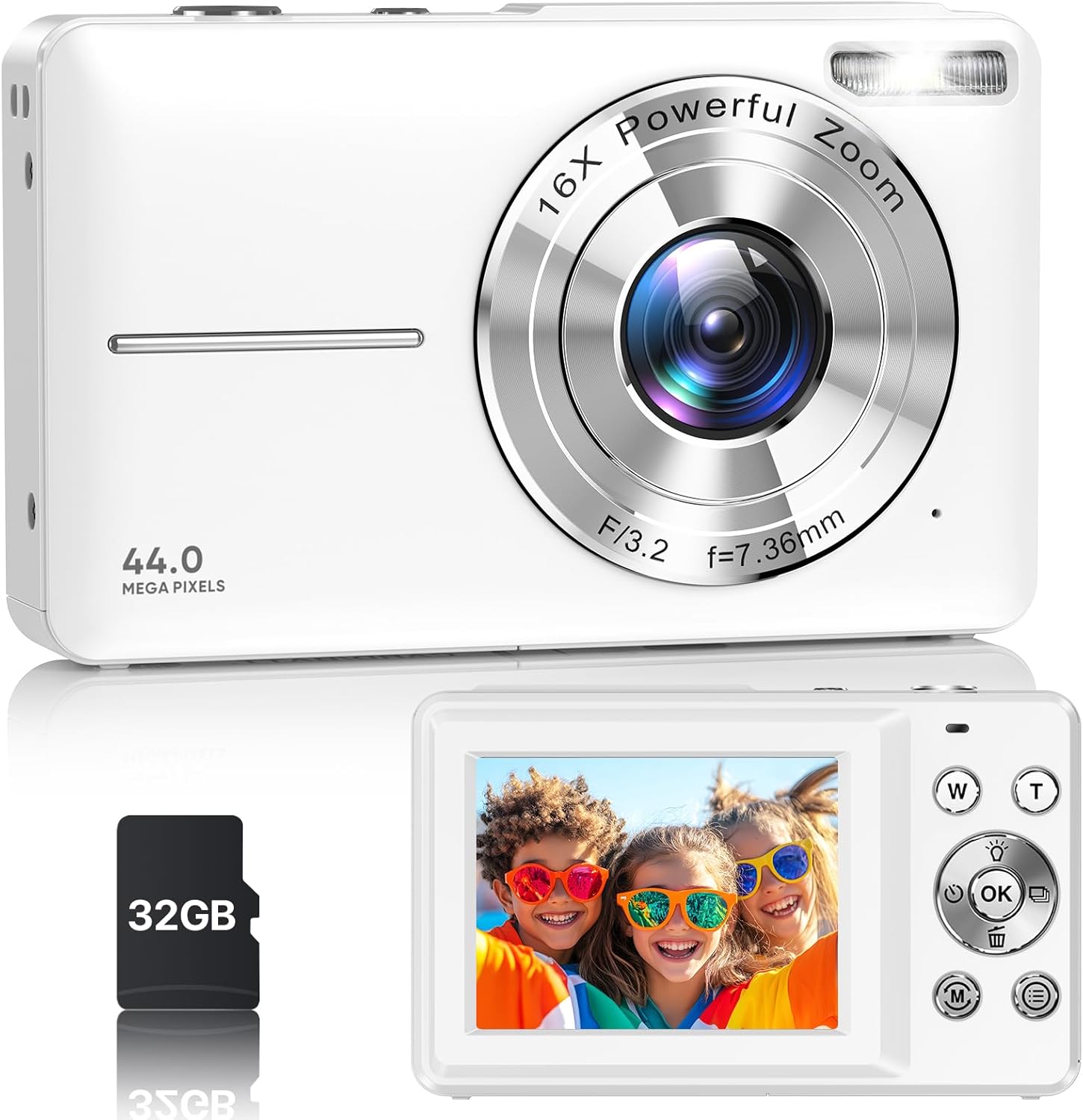
In an era dominated by smartphone photography, the dedicated digital camera occupies a unique and surprisingly resilient niche. While phones offer convenience, they often lack the tactile ergonomics, dedicated optical zoom, and distraction-free interface that foster a genuine love for photography—especially for younger users, seniors, or beginners seeking a deliberate creative tool. Enter the Digital Camera, Latest FHD 1080P Digital Camera for Teens with SD Card Anti Shake Point and Shoot Cameras Portable 16X Zoom Compact Small Cameras for Kids Boys Girls Seniors with Wrist Strap. Despite its mouthful of a title, this device promises a streamlined, feature-rich experience designed to bridge the gap between toy cameras and complex professional gear. This review dissects the specifications, usability, and practical application of this compact shooter to determine if it lives up to its “must-have” billing.
Design and Ergonomics: Pocket-Sized Practicality
The first impression of this camera is defined by its portability. Marketed as a “compact small camera,” the form factor is deliberately slim, designed to slip effortlessly into a jacket pocket, a small purse, or a backpack side pocket. For the target demographics—teens heading to a concert, kids on a nature hike, or seniors on a morning walk—this lightweight profile is a critical advantage. It removes the barrier of “heavy gear,” encouraging users to actually bring the camera along rather than leaving it at home.
Ergonomics are tailored for smaller hands and those with limited dexterity. The inclusion of a wrist strap is a thoughtful, safety-first addition. It provides a physical tether, mitigating the risk of accidental drops—a common occurrence with enthusiastic children or users with mobility challenges. The control layout adheres to the classic “point-and-shoot” philosophy: a prominent shutter button, a mode dial or navigation pad, and the W/T (Wide/Telephoto) zoom lever positioned naturally under the thumb or index finger. There are no confusing PASM (Program, Aperture, Shutter, Manual) dials to master; the interface prioritizes immediacy over granular control.
Imaging Performance: The CMOS Sensor and 44MP Interpolation
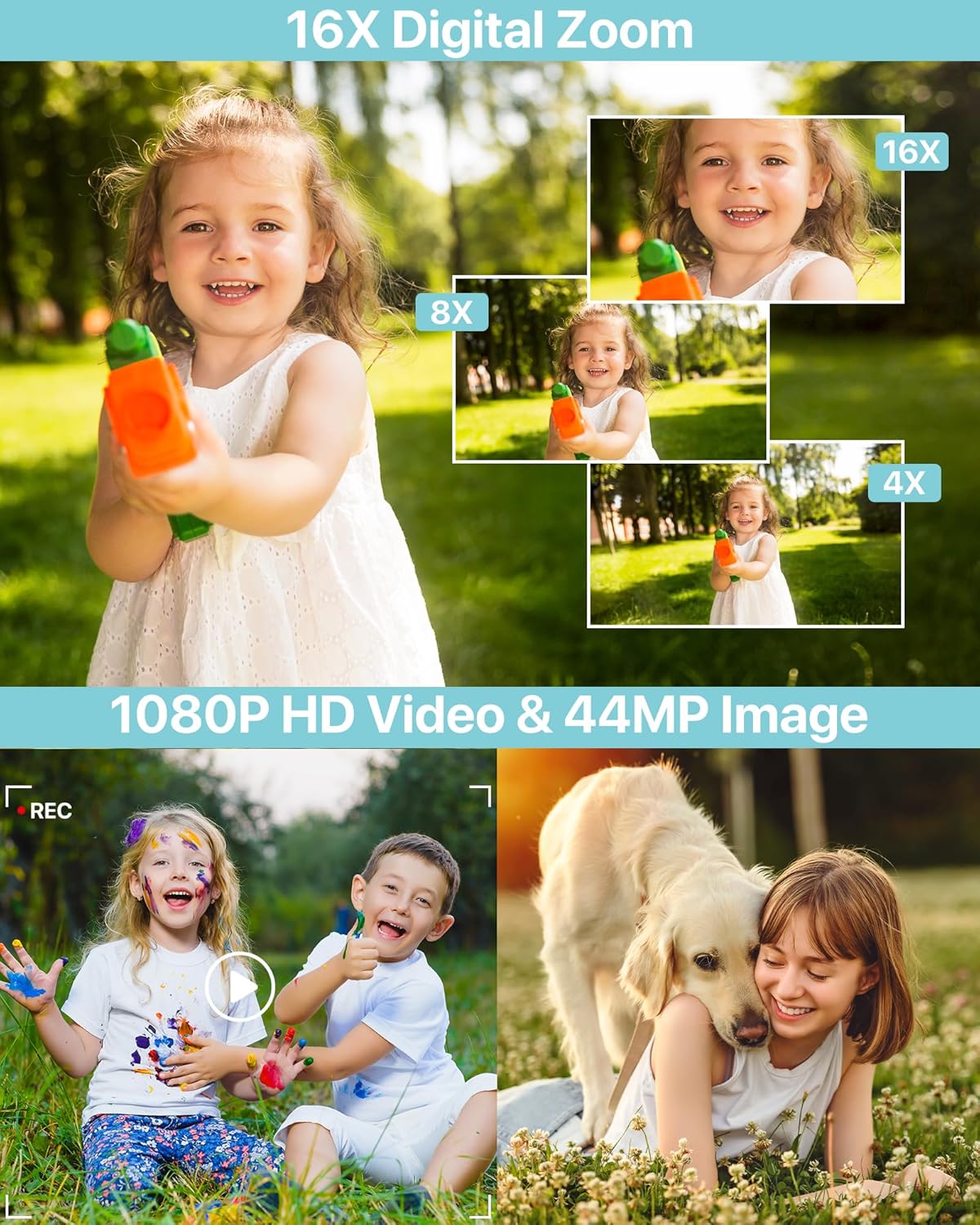
The headline specifications cite a “powerful CMOS processor” capable of 44 Megapixel (MP) quality images and FHD 1080P video recording. It is important to contextualize these numbers for the prospective buyer. In this category of entry-level compact cameras, the 44MP figure typically refers to interpolated resolution—software upscaling from a lower native sensor resolution (likely in the 8MP–12MP native range). However, for the intended use case—social media sharing, 4×6 or 5×7 prints, and viewing on phone or tablet screens—the resulting image files are perfectly adequate. They offer enough detail for cropping and digital zooming in post-processing without the muddy artifacts associated with earlier generations of budget cameras.
The FHD 1080P video capability (1920×1080 at 30fps) is the sweet spot for modern casual video. It strikes a balance between file size manageability and visual fidelity. Files are small enough to transfer quickly via the included USB cable or SD card reader, yet sharp enough for YouTube uploads, family archives, or school projects. The presence of an internal microphone and speaker allows for synchronous audio recording and immediate playback review on the camera’s rear LCD screen, a feature often omitted in ultra-budget models.
The “Anti-Shake” Factor and Low Light Versatility
One of the standout features in the spec sheet is Image Stabilization (Anti-Shake). In a camera lacking optical image stabilization (OIS)—which requires moving lens elements or a floating sensor—this is almost certainly Electronic Image Stabilization (EIS). EIS works by cropping the sensor readout slightly to create a buffer zone for motion correction. For still photography, this translates to a higher effective ISO sensitivity and faster shutter speeds to combat blur. For video, it smooths out the micro-jitters inherent in handheld shooting.
Coupled with stabilization is the Built-in Fill Light. This is a significant differentiator. Many compact cameras in this price bracket rely solely on a high-power LED flash, which often creates harsh, “deer-in-headlights” lighting and red-eye. A fill light (likely a lower-intensity, constant LED) allows for more natural illumination in dim restaurants, evening campfires, or indoor birthday parties. It also serves as a focus assist lamp, helping the autofocus system lock onto subjects in low-contrast environments. This dual approach to low-light management—stabilization for motion, fill light for exposure—makes the camera genuinely viable for “indoors/outdoors situations” as advertised.
Zoom Capability: 16X Digital Zoom Realities
The 16X Digital Zoom is a specification that requires careful expectation management. Unlike optical zoom, which uses lens mechanics to magnify the image without quality loss, digital zoom crops into the sensor’s pixel array. At 1X, you are using the full sensor. At 16X, you are using a tiny fraction of the central pixels, effectively blowing up a small crop to the full 44MP/1080P output size.
- Practical Usage: The zoom is controlled via the W/T button, offering tactile control superior to pinch-to-zoom on a touchscreen.
- Best Case: In bright daylight, at moderate zoom levels (2X–4X), results are usable for identifying distant subjects (a bird on a wire, a player on a field).
- Limitation: At the extreme 16X end, expect visible noise, softness, and “watercolor” artifacts from noise reduction algorithms.
- Verdict: It is a functional “reach” tool for identification and composition, not a wildlife photography lens. For teens at a stadium or kids spotting planes, it adds a layer of fun and utility that fixed-lens cameras lack.
Feature Set: The Creative Toolkit
Where this camera attempts to punch above its weight class is in its multifunctional feature suite. The description lists 20 filters, anti-shaking, self-timer, continuous shooting, date stamp, time-lapse recording, smile capture, and face detection. This transforms the device from a simple capture tool into a creative playground.
- 20 Filters: These in-camera effects (likely including Vintage, B&W, Sepia, Vignette, Lomo, etc.) allow for instant stylization without needing a phone app. For teens curating an Instagram aesthetic or kids experimenting with mood, this is instant gratification.
- Time-Lapse & Continuous Shooting: These advanced modes are rare in this segment. Time-lapse compresses hours into seconds (clouds moving, flowers opening), teaching patience and observation. Continuous shooting (burst mode) increases the odds of catching the perfect mid-air jump or candid smile.
- Smile Capture & Face Detection: Automating the “decisive moment.” The camera triggers the shutter when a smile is detected, reducing the “blinked eyes” or “looking away” failure rate common in group selfies.
- Self-Timer: Essential for the solo traveler or group shot where the photographer wants to be in the photo.
- Date Stamp: A “set it and forget it” feature beloved by parents and seniors for automatic photo organization and nostalgia preservation.
The Webcam & Vlogging Pivot: Pause Function and PC Connectivity
The modern definition of a “digital camera” has expanded to include streaming capabilities. This model features a Webcam Mode, activated by connecting via USB to a computer and pressing the Shutter and Power buttons simultaneously. In an age of remote learning, Zoom calls, and Twitch/YouTube streaming, this dual-purpose functionality significantly extends the device’s value proposition. It eliminates the need for a separate dedicated webcam, offering superior optics and positioning flexibility compared to a laptop’s built-in module.
Complementing this is the Pause Function during video recording. This is a “quality of life” feature often missing even in mid-range cameras. It allows the user to stop and resume recording within the same file. For vloggers recording a “day in the life” or students recording a presentation in segments, this drastically reduces post-production editing time—no stitching dozens of 10-second clips together.
Power, Storage, and Connectivity
Battery Life: The description claims “long-lasting battery life… even after long use,” noting the camera “retains its battery charge.” This suggests a decent capacity Lithium-Ion cell (likely 700mAh–1000mAh range) with efficient power management. For a day trip shooting intermittent photos and short clips, a single charge should suffice. The inclusion of a USB cable allows for charging via power banks—a critical capability for travel.
Storage: The camera supports an SD Card (sold separately or included in specific bundles). The product description includes a vital usage warning: “Once the SD card is formatted, you should not format it again. (Only format new SD cards for the cameras use the first time). As a suggestion, you’d better backup the photos to your computer from time to time.” This highlights the camera’s file system sensitivity. Users must treat the SD card as the primary archive and the camera as the capture device. Formatting in-camera initializes the file structure (DCIM folders); formatting repeatedly or on a computer can corrupt the file allocation table, leading to data loss. The provided USB cable transfers photos to a computer but cannot be used for printing directly. Printing requires a transfer to a phone/PC first.
Tripod Mount: The presence of a Standard 1/4 Inch Tripod Mount on the bottom elevates the camera from “handheld only” to “studio capable.” It enables stable long exposures (night photography), self-portraits via timer, and fixed-position vlogging/time-lapse setups.
Target Audience Analysis: Who Is This Really For?
The marketing casts a wide net: Teens, Kids, Boys, Girls, Seniors, Beginners.
- For Kids/Teens: It is a “first real camera.” It teaches composition (via the viewfinder/LCD), exposure basics (via scene modes), and file management (SD cards). The durability (“high-quality materials, safe and durable”) and wrist strap survive backpack life. The filters and effects gamify the experience.
- For Seniors: The large buttons, simple menu logic, anti-shake (compensating for hand tremors), date stamp (memory aid), and wrist strap (security) address specific accessibility needs. The webcam function facilitates easy video calls with grandchildren without fiddling with drivers.
- For Beginners/Travelers: As a “glovebox camera” or “purse camera,” it offers a distinct look (dedicated lens rendering, flash control) separate from a smartphone aesthetic, without the bulk of a mirrorless system.
The “Retro” Aesthetic and Build Quality
The promotional imagery and description lean into a “retro camera” aesthetic. While the internals are modern solid-state electronics, the exterior styling—likely featuring silver accents, textured grips, and analog-inspired dials—taps into the current trend of “dumb tech” or digital minimalism. It looks like a camera, feels like a camera, and operates like a camera. This psychological distinction matters; holding a dedicated device shifts the user’s mindset from “doom-scrolling” to “image-making.”
Support Ecosystem
The manufacturer emphasizes a “dedicated and experienced 24/7 support team… for all after purchase troubleshooting, questions and technical help.” For a non-major brand (implied by the generic listing style), this is a crucial trust signal. Entry-level electronics often suffer from poor documentation; accessible support mitigates the risk of a “bricked” device due to a user error (like the SD card formatting issue mentioned above).
Critical Considerations & Limitations
No review is complete without the caveats inherent to the price point and form factor:
- Digital Zoom ≠ Optical Zoom: Do not buy this expecting crisp 16x magnification. It is a crop tool.
- Low Light Noise: The “powerful CMOS” and fill light help, but physics dictates a small sensor (likely 1/2.3″ or smaller) will produce noise at ISO 400+. The fill light range is limited to ~3–5 feet.
- LCD Visibility: The screen size isn’t specified in the text, but typically these are 2.4″–2.8″ TFT screens. They may struggle in direct, bright sunlight (washing out), making composition difficult outdoors without a viewfinder (which this lacks).
- Audio Quality: The internal mono mic is functional for ambient sound but will pick up handling noise (zoom motor, button clicks) and wind noise. No external mic jack is mentioned.
- File Transfer Workflow: The lack of Wi-Fi/Bluetooth (not mentioned in specs) means a wired USB connection or physical SD card removal is mandatory for offloading. This is a “friction point” for the smartphone generation used to instant AirDrop/Share Sheet workflows.
Final Verdict: A Capable Gateway to Photography
The Latest FHD 1080P Digital Camera succeeds precisely because it knows what it is—and what it isn’t. It does not pretend to be a Sony RX100 or a Canon G7X competitor. It is a dedicated, distraction-free image-making appliance.
Its strengths lie in its holistic feature set: the combination of stabilization, fill light, 16x reach, creative filters, time-lapse, webcam utility, and tripod mounting creates a Swiss Army Knife of visual capture. For a teenager documenting a senior year, a grandparent recording a grandchild’s first steps, or a family needing a rugged, shareable camera for a beach vacation where a $1000 phone risks sand and surf damage, this device offers exceptional utility per dollar.
The warnings regarding SD card management and the realities of digital zoom are not flaws, but parameters for successful operation. If the buyer respects the workflow (backup often, format once, use optical-range zoom primarily), this camera delivers on its promise: high-quality pictures even in low light, long-lasting battery life, and a portable, multifunctional tool that develops “photographic abilities and observation skills.”
It strips away the complexity of modern tech—no app logins, no cloud sync errors, no notification pop-ups—and returns the user to the fundamental joy of point, shoot, keep. For the price of a few months of streaming subscriptions, it provides a tangible, tactile creative outlet that a smartphone simply cannot replicate.