




Price:
(as of Jul 26, 2026 23:05:12 UTC – Details)

Capturing Clarity: A Comprehensive Review of the 8K Digital Camera (96MP, WiFi, Dual Screen) for Emerging Creators
In an era dominated by smartphone photography, the dedicated digital camera occupies a unique and vital niche. It offers a tactile, intentional shooting experience that a touchscreen often cannot replicate—physical buttons, optical zoom mechanics, and a form factor built purely for imaging. The 8K Digital Camera, 96MP WiFi Camera for Photography with Dual Screen (White) positions itself squarely in the “bridge” category: a device designed to elevate the casual snap-shooter into a capable content creator without the steep learning curve or financial barrier of interchangeable lens systems. Marketed explicitly toward teens, beginners, travelers, and vloggers, this compact point-and-shoot arrives as a comprehensive kit promising high-resolution stills, high-definition video, and modern connectivity. This review examines the specifications, design philosophy, feature set, and practical utility of this device based strictly on its manufacturer specifications and feature list.
Design Philosophy: Ergonomics and the Dual-Screen Advantage
The first interaction with any camera is physical, and this model adopts a familiar, compact “point-and-shoot” silhouette. Finished in a clean white aesthetic, it presents a modern, approachable look that appeals to its target demographic of younger users and style-conscious travelers. The defining physical characteristic, however, is the dual-screen configuration.
The rear houses the primary display for menu navigation, composition, and playback. The critical innovation for the social media generation is the front-facing screen. The product description highlights this as a core feature for “Selfies, Vlogs & Social Content.” In practical terms, this transforms the camera from a “point-at-subject” device into a “point-at-self” tool instantly. For a solo traveler or a teen creating content for platforms like YouTube or TikTok, the frustration of guessing framing—or worse, relying on a smartphone’s lower-quality front camera—is eliminated. The user can see exactly what the lens sees in real-time, ensuring the horizon is level, the lighting is flattering, and the composition is intentional before the shutter is pressed.
The form factor is described as “compact” and “lightweight,” designed to slip into a backpack, purse, or travel bag. This portability is a key selling point; the best camera is the one you have with you, and the physical dimensions here suggest zero friction for daily carry. The inclusion of a lanyard and pouch in the box reinforces this “grab-and-go” philosophy, protecting the investment during the chaotic energy of school events, theme parks, or hiking trails.
Imaging Performance: Decoding the 8K/96MP Promise
The headline specifications—8K Video Resolution and 96MP Still Images—are the primary anchors of this camera’s value proposition. In the context of a sub-professional device, these numbers represent interpolated or pixel-binned maximums derived from a high-density sensor, rather than the native output of a full-frame cinema sensor. However, for the intended use case—”Everyday Memories,” “School Events,” “Family Trips,” and “Social Content”—the distinction is largely academic. The output resolution far exceeds the requirements for 4K monitors, high-quality prints, or social media compression algorithms.
The description frames this capability as a way to capture “more detail than a phone snapshot.” This is a crucial differentiator. While modern smartphones rely heavily on computational photography (multi-frame processing, AI sharpening), a dedicated sensor with a physical shutter and larger pixel pitch (relative to a phone module) handles dynamic range and low-light noise differently. The 96MP capability allows for significant cropping latitude. A user can shoot a wide scene—perhaps a school play or a soccer match—and crop in tightly on a specific face or action later, retaining usable resolution for printing or digital zoom. This effectively extends the utility of the fixed lens.
Video capture at 8K provides a similar “future-proofing” buffer. Even if the final delivery is 1080p or 4K, shooting at 8K allows for digital stabilization cropping, panning/zooming in post-production (the “Ken Burns” effect), and grabbing high-resolution still frames from video footage (approx. 33MP per frame), a feature invaluable for vloggers needing thumbnails or promotional stills.
The Vlogging Toolkit: Autofocus, Anti-Shake, and Zoom
A camera marketed for vlogging lives or dies by its ability to handle motion and distance. This model addresses the “shaky cam” aesthetic inherent to handheld shooting with Electronic Anti-Shake (EIS) support. While not a gimbal replacement, EIS uses sensor cropping or algorithmic frame alignment to smooth out the micro-jitters of walking, breathing, or hand-holding at arm’s length. For “casual videos” and “travel clips,” this is often sufficient to render footage watchable without inducing motion sickness in the viewer.
Complementing stabilization is Fast Autofocus. The description emphasizes keeping “faces, pets, scenery, and moving moments clear.” For a beginner, manual focus is a barrier; reliable AF-C (Continuous Autofocus) with face/eye detection (implied by “faces”) is the single most important feature for a “set it and forget it” experience. It ensures that when the user spins the camera around for a selfie via the front screen, the focus snaps to their eyes instantly, not the background.
The 16X Digital Zoom extends the reach of the fixed lens. It is vital to distinguish this as digital zoom (cropping the sensor) rather than optical zoom (moving lens elements). At the full 16x extent, image degradation (noise, softness) is inevitable. However, used judiciously—perhaps 2x–4x—it leverages the high 96MP sensor resolution to “bring distant subjects closer” effectively. The description cites specific scenarios: “school performance, sports day, concert, or travel view.” In these well-lit scenarios, the penalty of digital zoom is minimized, allowing the user to frame a tight shot of a performer on stage or a landmark across a plaza without physically moving.
Connectivity and Workflow: The WiFi Bridge
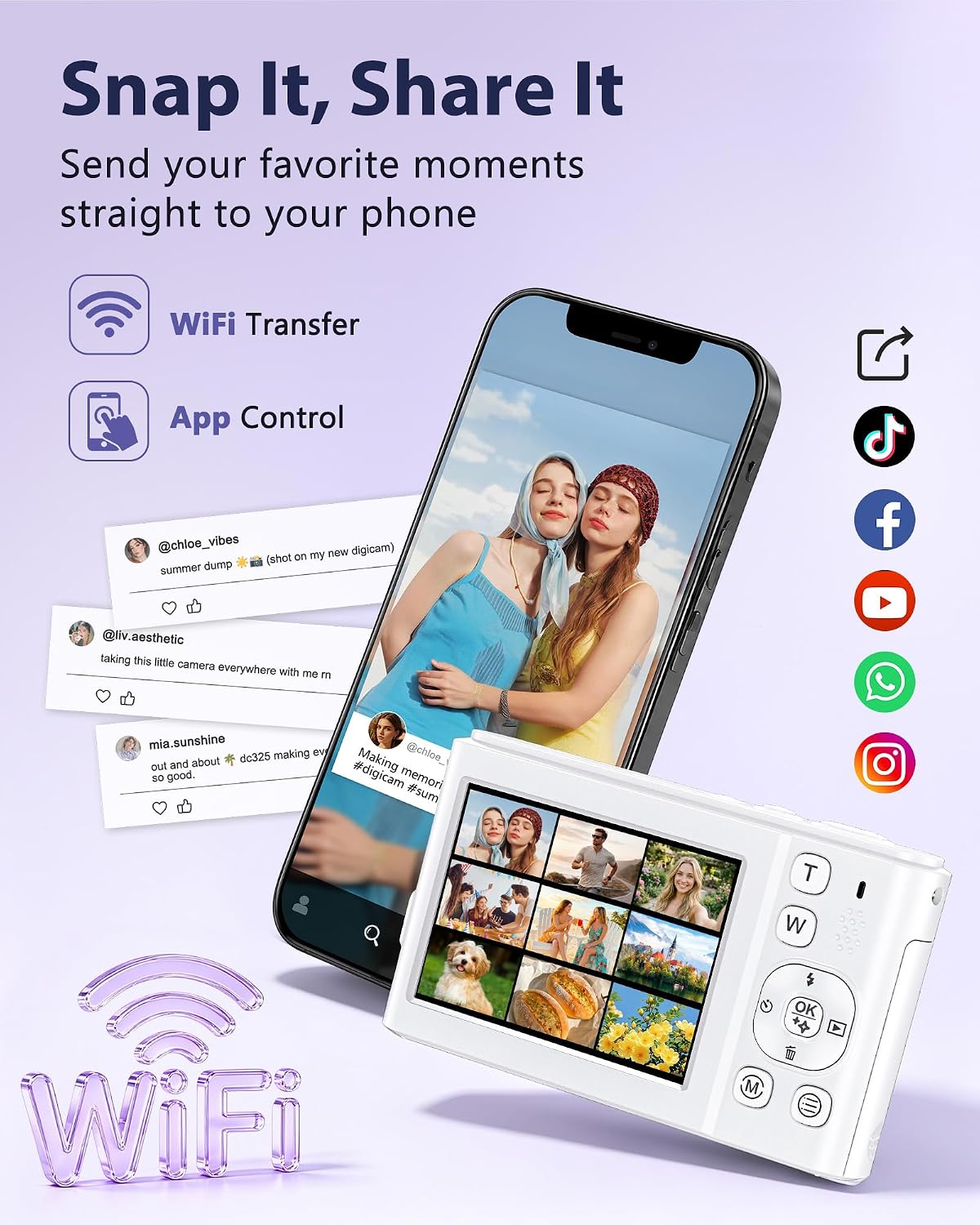
The modern creator’s workflow does not end at the shutter press; it ends at the “Post” button. The inclusion of Built-in WiFi Transfer via a companion app addresses the historical friction point of dedicated cameras: the “SD card to computer to phone” shuffle. By enabling direct transfer to a smartphone, the camera integrates into the existing mobile editing ecosystem (Lightroom Mobile, CapCut, InShot, native Instagram/TikTok editors).
The description notes this is “helpful for road trips, vacations, campus life, and group activities.” This is accurate. The ability to offload a day’s shoot to a phone in the evening—selecting keepers, applying filters, and backing up to the cloud—while the camera battery charges, streamlines the process immensely. It positions the camera not as a replacement for the smartphone, but as a high-quality lens module for the smartphone’s processing and distribution engine.
Creative Control: Modes, Filters, and Accessibility
For the beginner, the “Auto” mode is home base. But growth requires experimentation. The camera offers 8 Shooting Modes and 60 Filters. While the specific modes aren’t listed, a standard complement at this level typically includes Portrait, Landscape, Night, Sports, Macro, and perhaps Panorama or Time-lapse. These modes adjust aperture (simulated), shutter speed, ISO, and white balance presets to optimize for specific scenes, teaching the user the effect of settings before they understand the mechanics.
The 60 Filters cater directly to the “Social Content” use case. In-camera filtration—retro film looks, high-contrast B&W, vivid pop, vintage fade—allows for a finished “look” straight out of camera (SOOC). This reduces the need for post-processing for casual sharing, a significant time-saver for teens and busy travelers who want to share a “vibe” immediately.
The “Ready-to-Use” Ecosystem: Unboxing Value
A major pain point for first-time camera buyers is the hidden cost of accessories. The manufacturer has aggressively addressed this by bundling a complete starter kit. The box contains:
- 32GB Memory Card: Removes the immediate “which card do I buy?” confusion and allows shooting 8K video/96MP photos immediately.
- 2 Rechargeable Batteries: This is perhaps the most practical inclusion. Compact cameras have smaller batteries; a single charge rarely lasts a full day of 8K recording or heavy LCD use. A hot-swappable second battery doubles effective shooting time, essential for “travel” and “all-day events.”
- Charging Cable: Standard USB charging (likely USB-C) allows power bank top-ups on the go.
- Lanyard & Pouch: Immediate protection and carry solution.
- User Manual: Physical documentation for offline reference.
This “ready-to-use out of the box” approach lowers the barrier to entry to near zero. It is an excellent value proposition for a gift purchase (birthdays, holidays) where the recipient wants to start shooting the moment they open the box.
Target Audience Alignment: Teens, Beginners, and Travelers
The product description is remarkably specific about who this is for, and the feature set aligns tightly with those personas.
- Teens / Older Children: The dual screen satisfies the selfie/social urge. The simple “Point and Shoot” operation (no “professional settings” required) prevents frustration. The durable pouch/lanyard withstands backpack life. The filters provide instant creative gratification.
- Beginners: The Autofocus and Anti-Shake handle the technical heavy lifting. The Scene Modes act as training wheels for exposure concepts. The WiFi app provides a familiar smartphone interface for settings and review.
- Travelers: The lightweight/compact form factor is carry-on friendly. The 2 batteries + power bank charging solve the “wall outlet scarcity” problem. The 16x zoom covers the “I can’t get closer” problem. The 32GB card handles a day’s shooting, with WiFi offload clearing space for the next day.
- Vloggers: The Front Screen + 8K Video + Autofocus + Anti-Shake + WiFi Transfer creates a complete solo production pipeline: Frame -> Record -> Stabilize -> Transfer -> Edit -> Post.
Limitations and Considerations (Inferred from Specs)
A balanced review must acknowledge where the spec sheet implies constraints.
- Low Light Performance: Small sensors (necessary for this price/size) struggle in dim environments. “Anti-Shake” helps handheld blur, but high ISO noise will appear in dark rooms or night scenes. The flash (implied standard on compacts) will be the primary low-light tool.
- Digital Zoom Quality: As noted, 16x is a maximum theoretical reach. Optical quality peaks at 1x; users should “zoom with their feet” when possible.
- Audio: The description is silent on microphone inputs (3.5mm jack) or advanced audio controls. Vloggers will likely rely on the built-in stereo mics, which are susceptible to wind and handling noise. An external mic attachment via hot shoe is not mentioned.
- Build Quality: “Lightweight” and “Compact” usually imply polycarbonate construction. It is not weather-sealed. The pouch is essential for dust/sand protection at the beach or trail.
Conclusion: A Purpose-Built Gateway to Better Imaging
The 8K Digital Camera, 96MP WiFi Camera with Dual Screen does not pretend to be a professional cinema camera or a high-end mirrorless hybrid. It is a focused, highly specialized tool designed to solve the specific problems of the smartphone-era beginner: framing yourself (Dual Screen), sharing instantly (WiFi), stabilizing shaky hands (Anti-Shake), reaching the stage (16x Zoom), and shooting all day (Dual Batteries).
By bundling the storage, power, and protection required to operate, it eliminates the “accessory tax” that often sours entry-level purchases. The 8K/96MP resolution figures provide a massive canvas for cropping, reframing, and future-proofing memories, ensuring that the moments captured today—school graduations, solo trips, family reunions—retain enough detail to be enjoyed on the display technology of tomorrow.
For the teen asking for their first “real camera,” the parent documenting a childhood that moves too fast, or the traveler tired of draining their phone battery by noon, this white point-and-shoot represents a compelling, low-friction argument for carrying a dedicated imaging device. It respects the user’s time (simple operation), their creativity (filters/modes), and their workflow (WiFi/app), proving that in the right hands, a compact camera is not obsolete—it is simply better at being a camera.