




Price:
(as of Jul 26, 2026 23:01:08 UTC – Details)

Xtra Muse Review: Redefining the Pocket Gimbal Camera Category
In the rapidly evolving landscape of content creation tools, the gap between smartphone convenience and dedicated camera quality has been a persistent battleground. Manufacturers have tried bridging this divide with action cameras, compact point-and-shoots, and handheld gimbals, but few devices manage to integrate the sensor size, stabilization mechanics, and professional codec support required for serious workflow into a truly pocketable form factor. The Xtra Muse enters this fray not merely as a “vlogging camera,” but as a hybrid device attempting to collapse a 1-inch sensor cinema camera, a 3-axis mechanical gimbal, and a high-bitrate video recorder into a single handheld unit. Based on its specifications and feature set, the Xtra Muse represents a significant engineering effort aimed squarely at the solo creator who demands cinematic image quality without the bulk of a rig.
The Core Imaging Pipeline: 1-Inch Sensor Meets 10-Bit Color
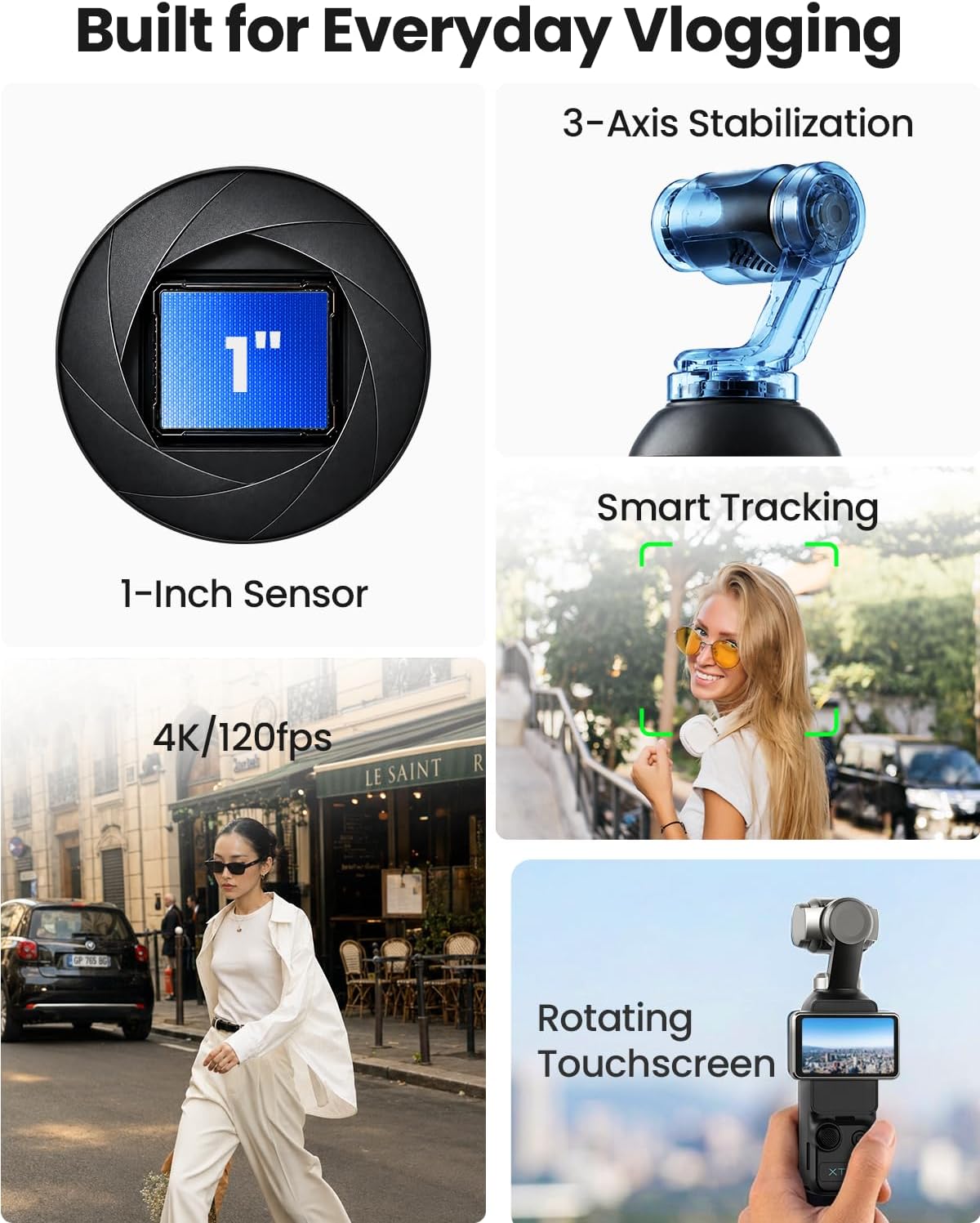
The headline specification of the Xtra Muse is its 1-inch CMOS sensor. In the hierarchy of sensor sizes, 1-inch sits in a sweet spot—significantly larger than the 1/1.7-inch or 1/2.3-inch sensors found in smartphones and action cameras, yet smaller than Micro Four Thirds or APS-C. This physical size advantage translates directly into light-gathering capability, dynamic range, and the coveted shallow depth of field (bokeh) that separates a subject from the background organically, without relying on computational photography artifacts.
Paired with this sensor is the ability to record 4K resolution at up to 120 frames per second (fps). This is a critical differentiator. Many compact cameras cap 4K at 30fps or 60fps, relegating 120fps to 1080p. By maintaining 4K resolution at high frame rates, the Muse allows for high-quality slow-motion footage that retains enough detail for cropping, stabilization in post, or extraction of high-resolution stills. For the vlogger or run-and-gun filmmaker, this means B-roll captured at 120fps can be conformed to a 24fps timeline for a 5x slow-motion effect without sacrificing the 4K delivery pipeline.
Perhaps the most “pro” feature hidden in the spec sheet is True 10-bit X-Log color recording. 8-bit video, standard on most consumer devices, offers 256 shades per color channel (16.7 million colors total). 10-bit expands this to 1,024 shades per channel—over one billion colors. This is not just a numbers game; it is a post-production necessity. The X-Log gamma curve preserves highlight and shadow detail, providing a flat image profile that acts as a digital negative. For creators coloring in DaVinci Resolve, Premiere Pro, or Final Cut, this latitude is the difference between a usable grade and banding artifacts in gradient skies or skin tones. The inclusion of this in a pocket device signals a target audience that understands color science.
Mechanical Stabilization: The 3-Axis Gimbal Advantage
Stabilization is where the Xtra Muse fundamentally diverges from competitors like the Sony ZV-1, DJI Osmo Pocket 3, or Insta360 GO series. While electronic image stabilization (EIS) crops the sensor and can introduce “jello” warp during fast motion, and sensor-shift stabilization (IBIS) has limited range, the Muse employs a physical 3-axis mechanical gimbal.
This mechanism physically moves the lens/sensor assembly to counteract yaw (pan), pitch (tilt), and roll (horizon leveling). The practical implication is stabilization without crop factor. The full 1-inch sensor readout is utilized for the image, meaning the field of view remains wide (crucial for vlogging selfie angles), and there is no digital degradation at the edges. The marketing highlights “Ultra-Steady Shooting” during dynamic activities—dancing, running, hiking—and a mechanical gimbal is the only technology capable of delivering truly “gimbal-smooth” footage in these scenarios without the tell-tale micro-jitters of EIS.
Furthermore, the gimbal enables the “Master Follow” feature. By mounting the unit on a tripod (via the included handle with 1/4″ thread), the camera becomes an autonomous camera operator. It tracks the subject’s face or body, panning and tilting the gimbal motors to keep the creator centered. This transforms the device from a handheld tool into a stationary robotic camera head, a unique utility for solo dance videos, fitness instruction, or presenters who need to move away from the camera.
Optics and Zoom: Fixed Lens Versatility
The integrated lens offers a 2x lossless zoom capability. On a fixed-lens camera, optical zoom is rare; digital zoom degrades quality. “Lossless” zoom here likely utilizes the high resolution of the sensor (likely 20MP+ for stills) to crop into the 4K video area (approx. 8.3MP) without interpolation. This provides a legitimate “punch-in” option for tighter framing or a classic 50mm-equivalent portrait look, adding compositional flexibility that most wide-angle-only action cams lack.
The mention of “Cinematic Bokeh” is a direct result of the sensor size combined with the lens aperture (likely around f/1.8 – f/2.8 equivalent). Unlike smartphones that simulate blur via LiDAR or dual-pixel data—which often struggles with hair, glasses, or complex edges—the Muse generates optical bokeh. The transition from sharp focus to blur is governed by physics, rendering highlights as smooth circles and handling translucent objects naturally.
Autofocus and Tracking: Keeping the Subject Sharp
A large sensor with a wide aperture creates a razor-thin depth of field, which demands a highly competent autofocus system. The Xtra Muse advertises “Fast Focusing” combined with “Face/Object Tracking.” In the context of a gimbal camera, AF performance is paramount because the camera is constantly moving. The system must distinguish between the subject and the background while the gimbal motors are actively counteracting hand shake.
The “Tap & Shoot” functionality on the 2-inch touchscreen allows for rapid focus point selection. For vloggers holding the camera at arm’s length, face/eye detection is the primary mode. The effectiveness of this tracking—specifically its stickiness when the subject turns away, walks behind an obstacle, or moves quickly toward the lens—defines the usability of the device. The specification suggests a PDAF (Phase Detection Autofocus) or hybrid system capable of keeping pace with the 120fps readout speed.
Form Factor, Ergonomics, and Usability
The “Pocket Size” claim is central to the value proposition. The device integrates the grip, battery, screen, gimbal mechanics, and lens into a single rectangular block. The 2-inch touchscreen is described as “expansive” relative to the body, featuring a 750-nit brightness rating. This is a crucial spec for outdoor usability; typical smartphone screens hit 800-1000 nits in high-brightness mode, so 750 nits suggests the screen remains visible in direct sunlight—a common failure point for cheaper action cameras.
The “Flip & Shoot” mechanism implies a rotating screen or a rotating lens module. Given the gimbal form factor, a flip-up touchscreen is the standard solution for self-framing. The inclusion of a dedicated handle with a 1/4″-20 thread in the standard bundle expands the mounting ecosystem immediately: tripods, selfie sticks, suction cups, and chest mounts become native options without proprietary cages.
Battery life is rated at 161 minutes. For a device driving a 1-inch sensor, a bright touchscreen, and three gimbal motors simultaneously, this is a respectable figure. It suggests roughly 2.5 hours of continuous recording at standard settings, though 4K/120fps 10-bit recording will likely draw more current, reducing that window. The inclusion of a carrying bag and wrist strap in the “Standard Bundle completes the “grab-and-go” narrative.
Connectivity and Ecosystem: The Xtra App and Live Streaming
Modern cameras cannot exist in isolation. The Xtra Muse integrates Bluetooth Audio support, allowing direct connection of wireless lavalier microphones (like DJI Mic, Rode Wireless GO, or Hollyland Lark) without cables dangling into the frame. This solves the audio quality issue—often the weak link in compact cameras—while maintaining the clean aesthetic.
The “Xtra App” provides the smartphone bridge for firmware updates, remote control, footage transfer, and likely quick-editing templates. The “Go Live” feature indicates native RTMP/RTMPS support for streaming directly to YouTube, Twitch, TikTok, or Instagram via a tethered phone connection (USB or Wi-Fi) or potentially built-in Wi-Fi/5G (though the spec implies phone tethering). For the “IRL” streamer or live podcaster, the combination of 1-inch image quality, mechanical stabilization, and direct streaming capability is a powerful niche package.
Timecode Sync support is a surprising inclusion for this class of device. Usually reserved for cinema cameras (RED, ARRI, Sony Venice, FX series), timecode allows multi-camera synchronization in post-production without clapper slates or audio syncing waveforms. If the Muse outputs timecode via HDMI or Bluetooth to an external recorder/other cameras, it positions itself as a legitimate B-cam or crash-cam for professional productions.
Video Specifications Summary
- Sensor: 1-inch CMOS
- Max Video Resolution: 4K (3840×2160) @ 120fps
- Color Science: 10-bit X-Log (1 Billion+ Colors)
- Stabilization: Mechanical 3-Axis Gimbal (Yaw, Pitch, Roll)
- Zoom: 2x Lossless Digital Zoom
- Autofocus: Fast AF with Face/Object Tracking
- Screen: 2-inch Touchscreen, 750 nits, Flip-capable
- Audio: Bluetooth Audio Input, Built-in Mics
- Battery: ~161 Minutes (CIPA/Standard)
- Connectivity: App Control, Live Streaming (Go Live), Timecode Sync
- Mounting: 1/4″-20 Thread (via included handle)
Who Is This For? (Market Positioning)
The Xtra Muse occupies a unique coordinate in the market map.
- Vs. Smartphone (iPhone 15 Pro / S24 Ultra): The Muse wins on optical bokeh, mechanical stabilization (no crop/wobble), 10-bit log workflow, heat dissipation for long takes, and dedicated ergonomics. The phone wins on computational photography (HDR stills, night mode), ecosystem integration, and screen size.
- Vs. DJI Osmo Pocket 3: The closest direct rival. The Pocket 3 also has a 1-inch sensor and 3-axis gimbal. The Muse differentiates with the explicit 10-bit X-Log marketing, Timecode Sync, and potentially a different color science/processing engine. The form factors are nearly identical; the choice comes down to UI preference, app ecosystem, and specific codec implementation.
- Vs. Sony ZV-1 II / ZV-E10: Sony wins on lens interchangeability (ZV-E10) or larger sensor (ZV-1 II has 1-inch but no gimbal). The Muse wins on integrated stabilization. A ZV-1 II on a gimbal is a two-piece kit; the Muse is one.
- Vs. Action Cams (GoPro Hero 12 / Insta360 Ace Pro): Action cams win on ruggedness, waterproofing, and mount variety. The Muse wins on sensor size (1-inch vs 1/1.3″), low light, bokeh, and log recording flexibility.
Critical Considerations
While the spec sheet is impressive, potential buyers should weigh a few inherent constraints of the form factor.
- Thermals: Sustained 4K/120fps 10-bit recording generates significant heat in a sealed, pocket-sized body with no active cooling. Recording limits (time caps) or thermal throttling (reduced frame rate/brightness) are physical realities.
- Audio Handling: While Bluetooth audio is supported, the internal microphones on gimbal cameras often pick up motor whine during quiet scenes. External mic usage is highly recommended for professional audio.
- Durability: A mechanical gimbal has moving parts. It is not waterproof, dustproof, or shockproof like an action camera. The “Pocket Camera” designation implies care is needed.
- Low Light at 120fps: High frame rates require high shutter speeds (1/240s+), demanding immense light. The 1-inch sensor helps, but 4K/120fps in dim interiors will require high ISO, introducing noise that 10-bit color cannot fix.
Conclusion
The Xtra Muse is a compelling proposition for the specific creator who has outgrown their smartphone but refuses to carry a camera bag. It successfully integrates the three pillars of modern “cinematic” video—Large Sensor (1-inch), Professional Codec (10-bit Log), and Mechanical Stabilization (3-Axis Gimbal)—into a device that fits in a jacket pocket.
It is not a camera for everyone. The stills photographer will miss the zoom range and viewfinder of an interchangeable lens system. The adrenaline junkie will miss the waterproofing of an action cam. But for the vlogger, the traveling filmmaker, the live streamer, and the solo documentary shooter, the Muse removes the friction between “I see a shot” and “I have a stabilized, color-gradable, shallow-depth-of-field 4K clip.” It represents a maturation of the pocket gimbal category from a gadget into a legitimate production tool. If the autofocus reliability and thermal management hold up in real-world use, the Xtra Muse stands as a benchmark for what an all-in-one creator camera can be.