


Price:
(as of Jul 26, 2026 19:46:28 UTC – Details)

KODAK PIXPRO FZ45 Review: Simplicity Meets Functionality in a Compact Travel Companion
In an era dominated by smartphones boasting computational photography and multi-lens arrays, the dedicated compact camera occupies a unique and often misunderstood niche. The KODAK PIXPRO FZ45 enters this space not as a technological marvel designed to rival interchangeable lens systems, but as a purpose-built tool for a specific demographic: families, travelers, and beginners who prioritize tactile operation, optical versatility, and power independence over raw sensor size or connectivity features. This review examines the FZ45 strictly on the merits of its specifications and design philosophy, evaluating how its feature set translates into a practical imaging experience for everyday use.
Design Philosophy: The Case for Physical Controls
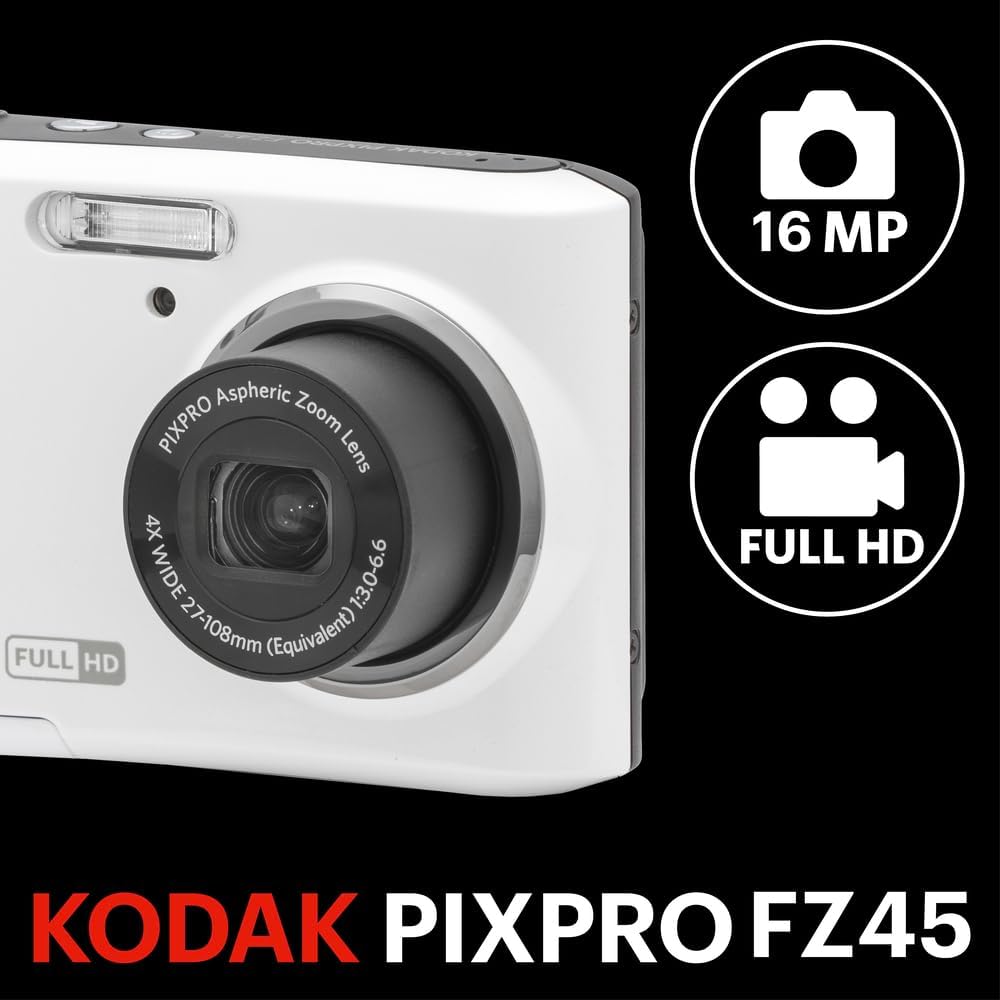
The most immediate distinction between the PIXPRO FZ45 and a modern smartphone is physical. The FZ45 is a traditional “point-and-shoot” in the truest sense, featuring a slim, lightweight chassis that fits comfortably in a pocket or small bag. The white finish gives it a clean, approachable aesthetic that differentiates it from the ubiquitous black slabs of consumer electronics.
Crucially, the camera retains “real buttons” and clear menus. For a generation raised on touchscreens, this might seem archaic; however, for the target user—perhaps a parent handing the camera to a child, a senior uncomfortable with gesture navigation, or a traveler wearing gloves—the tactile feedback of a physical shutter release, zoom rocker, and directional pad is a significant usability advantage. There is no learning curve here. The interface is designed for immediate comprehension: power on, point, shoot. This reduction of friction between the user and the act of taking a photograph is the FZ45’s primary value proposition.
The 2.7-inch LCD screen serves as the sole composition and review mechanism. There is no electronic viewfinder (EVF), which is standard for this price tier. At 2.7 inches, the screen is adequate for framing and menu navigation, though users accustomed to 6-inch phone displays may find it modest. In bright sunlight, the reflective nature of LCDs can make composition challenging, a common limitation in this class of camera.
Imaging Core: The 16MP CMOS Sensor
At the heart of the FZ45 sits a 16-megapixel CMOS sensor. In the current market, 16MP might sound conservative—flagship phones push 48MP, 50MP, or even 200MP. However, for a 1/2.3-inch class sensor (typical for this category), 16MP represents a sweet spot. It avoids the diffraction limits and noise penalties of cramming higher pixel counts onto a small surface area.
The output is designed for “everyday shooting.” This translates to image files with sufficient resolution for standard prints (up to 8×10 or 11×14 inches), social media sharing, and 4K display viewing. The CMOS architecture allows for reasonably fast readout speeds, supporting the camera’s 1080p video capability and continuous shooting modes. Dynamic range and low-light performance will be inherently limited by the physical sensor size; this is not a camera for astrophotography or dimly lit indoor events without flash. But in daylight, at base ISO, the sensor delivers clean, colorful JPEGs that require zero post-processing—a key requirement for the “no complexity” user.
Optical Versatility: 4x Zoom and the 27mm Wide Angle
The defining hardware feature separating the FZ45 from a smartphone is its optical zoom lens. The 4x optical zoom covers a focal range equivalent to 27mm–108mm (35mm equivalent).
The 27mm wide-angle starting point is the standout specification here. Many budget compacts and older models start at 28mm or even 30mm. That single millimeter matters significantly in practical scenarios. Indoors, 27mm allows the photographer to capture a full living room scene or a large family group around a dinner table without having to back into a wall. Outdoors, it accommodates expansive landscapes and architectural facades. It is a “wide enough” focal length that prevents the frustration of “I can’t fit it all in.”
At the telephoto end, 108mm provides genuine optical reach. Unlike digital zoom, which crops and degrades the sensor data, this optical magnification preserves the full 16MP resolution. This is invaluable for travel scenarios: capturing architectural details on a cathedral facade, zooming in on a performer on a stage, or grabbing a candid shot of a child playing on a beach from a distance. The zoom action is driven by a motorized lens barrel extending from the body—a mechanical process that adds a satisfying physicality to the shooting experience but does require a brief startup delay.
Video Capabilities: 1080p Full HD Practicality
The FZ45 records 1080p Full HD video. In a 4K world, this specification dates the camera on paper. However, in practice, 1080p remains the standard for most viewing scenarios: phone screens, tablets, HD televisions, and social media compression pipelines.
For the intended use cases—”travel clips, family moments, or simple vlogging”—1080p is pragmatic. File sizes are manageable, editing is lightweight (or unnecessary), and storage requirements are modest. The camera likely utilizes the optical zoom during video recording (a feature not always guaranteed in budget models), allowing for smooth focal length transitions while filming. Audio capture is handled by a built-in mono microphone; it will capture ambient sound adequately for family archives but lacks wind noise reduction or external mic input for serious vlogging. The 2.7-inch LCD articulates as a fixed rear screen, meaning self-framing for vlogging requires guesswork or a mirror, reinforcing that “simple vlogging” here implies casual handheld recording rather than professional content creation.
Power Architecture: The AA Battery Advantage
Perhaps the most polarizing yet practically brilliant specification of the FZ45 is its power source: two AA alkaline batteries.
In an industry obsessed with proprietary lithium-ion packs and USB-C charging, the AA format is a deliberate strategic choice. The product description highlights “convenient power anywhere without charging.” This is not marketing hyperbole; it is a logistical superpower for specific users.
Consider a multi-day camping trip, a cruise ship excursion with limited cabin outlets, or an international vacation where voltage converters are forgotten. AA batteries are sold in every convenience store, pharmacy, and airport kiosk on the planet. A user can carry a four-pack of spares weighing mere grams, effectively granting infinite camera uptime. Furthermore, the camera is compatible with rechargeable NiMH AA batteries (like Eneloop), offering the best of both worlds: the convenience of disposables for emergencies and the economy/ecology of rechargeables for daily use. There is no battery degradation anxiety after three years of storage; if the camera sits in a drawer for a year, fresh AAs bring it back to life instantly. For a “family camera” or “backup travel camera,” this reliability is arguably worth more than the slimmer profile a proprietary battery would allow.
Storage Flexibility: Modern Media Support
Despite the retro power choice, the storage media is thoroughly modern. The FZ45 accepts SD, SDHC, and SDXC cards up to 512GB, with a Class 10 speed rating recommendation.
This capacity ceiling is massive for a 16MP camera. A 512GB card can hold roughly 30,000 to 40,000 high-quality JPEGs or dozens of hours of 1080p video. For the average user, a single 64GB or 128GB card (inexpensive and ubiquitous) effectively becomes “infinite storage” for a year of family events. The Class 10 requirement ensures the buffer clears quickly enough for continuous shooting and smooth video writing, preventing the “busy” light from freezing the camera at a critical moment.
The “Travel and Family” Use Case: Synthesis
When we synthesize these components—16MP sensor, 27-108mm lens, AA power, 512GB support, physical controls—a clear profile emerges. The KODAK PIXPRO FZ45 is not a camera for the “enthusiast” looking for RAW files, manual exposure control, fast apertures (the aperture range is not specified but is typically f/3.2-f/6.5 on such lenses), or low-light prowess.
It is a camera for:
- The “Designated Photographer” Parent: At a birthday party or school play, the parent with the FZ45 isn’t draining their phone battery, isn’t distracted by notifications, and can hand the camera to a grandparent who knows exactly how to press the big silver button.
- The Lightweight Traveler: For a hiker counting ounces, the FZ45 + a spare AA set + a 128GB card offers weeks of shooting capability with zero charging infrastructure. The 27mm wide angle captures the vista; the 108mm zoom captures the eagle on the ridge.
- The First Camera Buyer: For a young teenager or a senior entering digital photography, the menu system is uncluttered. Auto mode handles exposure, white balance, and focus. Scene modes (likely including Portrait, Landscape, Sport, Beach, etc., standard for the line) offer simple overrides without explaining aperture priority.
Limitations in Context
A review based on specifications must acknowledge where the specs draw hard lines.
- Low Light: The small sensor and slow maximum aperture (typical for 4x zoom compacts) mean high ISO noise is significant. The built-in flash is the only solution for indoor night shots, resulting in the classic “bright subject, black background” look.
- Speed: Contrast-detect autofocus on a small sensor is not instantaneous. Shutter lag— the delay between pressing the button and the image capture—exists. It is unsuitable for fast-action sports.
- Connectivity: The provided description makes no mention of Wi-Fi, Bluetooth, or NFC. Image transfer requires removing the SD card or connecting a USB cable (likely Micro-USB or proprietary). This is a “shoot now, transfer later” workflow.
- Build Quality: “Slim, lightweight body” usually implies polycarbonate plastic construction. It is not weather-sealed, ruggedized, or drop-proof.
Verdict: A Tool, Not a Toy
The KODAK PIXPRO FZ45 succeeds by knowing exactly what it is. It does not pretend to be a mirrorless killer, nor does it apologize for lacking 4K video or a touchscreen. It is a dedicated photographic appliance.
Its value lies in the specific alchemy of optical zoom (27mm wide), AA battery independence, and physical ergonomics. For under $100 (typical street price for this class), it delivers a distinct shooting experience that a smartphone cannot replicate: the stability of a two-handed grip, the versatility of true optical glass moving back and forth, and the peace of mind that comes from power source ubiquity.
If your workflow lives in the cloud, if you edit in Lightroom Mobile, and if your camera is always your phone, the FZ45 is redundant. But if you want a glovebox camera that works after two years of neglect, a beach camera that doesn’t matter if sand gets in the zoom gears, or a first camera for a child that teaches composition without menus—the FZ45 is a highly competent, specification-honest solution. It is a reminder that sometimes, the best camera is the one that turns on instantly, zooms optically, and runs on batteries you can buy at a gas station.