



Price:
(as of Jul 27, 2026 00:39:08 UTC – Details)

KODAK PIXPRO FZ45 Review: Rediscovering Simplicity in a Smartphone World
In an era dominated by computational photography, multi-lens smartphone arrays, and the instantaneous gratification of social media sharing, the dedicated compact camera has largely retreated into a niche category. Yet, for a specific subset of users—parents wanting to hand a durable device to a child, travelers wary of draining their primary phone battery, or enthusiasts seeking a distinct “digital camera” aesthetic without the complexity of interchangeable lens systems—the category remains vital. The KODAK PIXPRO FZ45 enters this space not as a technological tour de force, but as a deliberate exercise in accessibility. It is a camera defined by what it lacks: no rechargeable battery anxiety, no touchscreen lag, no convoluted menu systems, and no requirement for a data plan. Based on its specifications and design philosophy, the FZ45 presents a compelling case for the enduring relevance of the simple point-and-shoot.
Design and Ergonomics: The Tactile Advantage
The first interaction with the PIXPRO FZ45 reveals its primary design directive: immediate usability. The specification sheet notes a “slim, lightweight body fits comfortably in a pocket or small bag,” but the physical reality of this form factor extends beyond mere portability. In a market where even entry-level cameras often mimic the minimalist, button-less design of smartphones, the FZ45 retains “real buttons.” This is a critical differentiator.
For the intended demographic—families, travelers, and beginners—tactile controls offer a distinct advantage over touchscreens. Physical buttons allow for operation by feel; a user can adjust zoom, trigger the shutter, or lock focus without pulling the camera away from their eye to hunt for a virtual control on a glare-prone screen. This “no learning curve” promise is rooted in muscle memory. The layout adheres to the classic point-and-shoot paradigm: a mode dial or simple toggle for switching between stills and video, a directional pad for navigation, and a dedicated shutter release with a discernible half-press for focus lock.
The 2.7-inch LCD screen serves as the sole composition and review interface. While 2.7 inches is modest by 2024 standards—where 3.0 to 3.2 inches is the norm—it is sufficient for the camera’s purpose. It functions as a clear window for framing and a reliable tool for playback verification. The absence of an electronic viewfinder (EVF) is expected at this price point and tier; the LCD is the viewfinder. For users upgrading from a smartphone, the experience of composing on a dedicated screen, detached from notifications and incoming calls, offers a surprisingly liberating creative headspace.
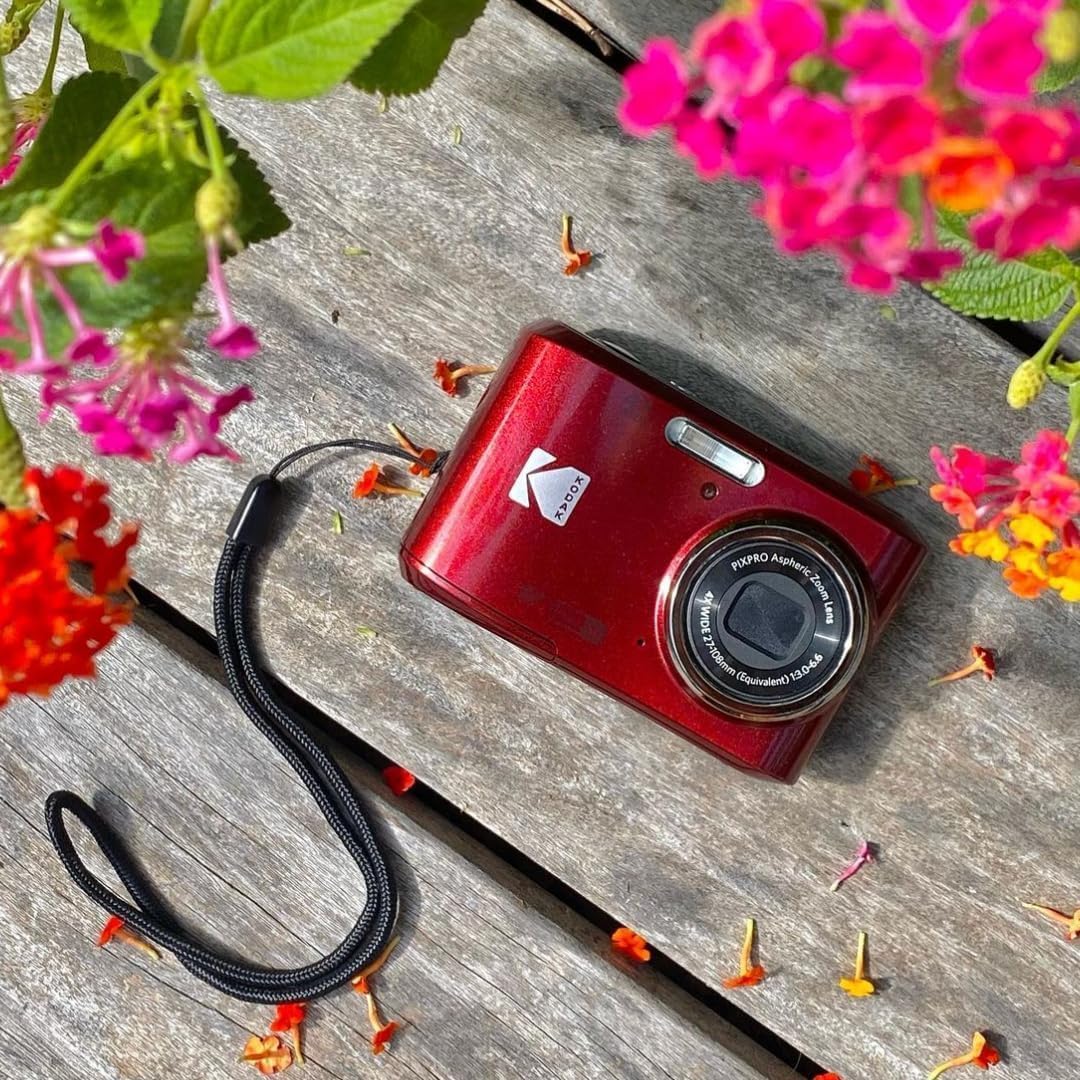
The aesthetic choice of a “Red” finish (as highlighted in the title) signals the camera’s personality. It is unapologetically a consumer lifestyle device, easy to spot in a cluttered bag or a child’s hand, moving away from the sober black/silver/gray palette of “serious” gear.
Imaging Performance: The 16MP CMOS and 27mm Perspective
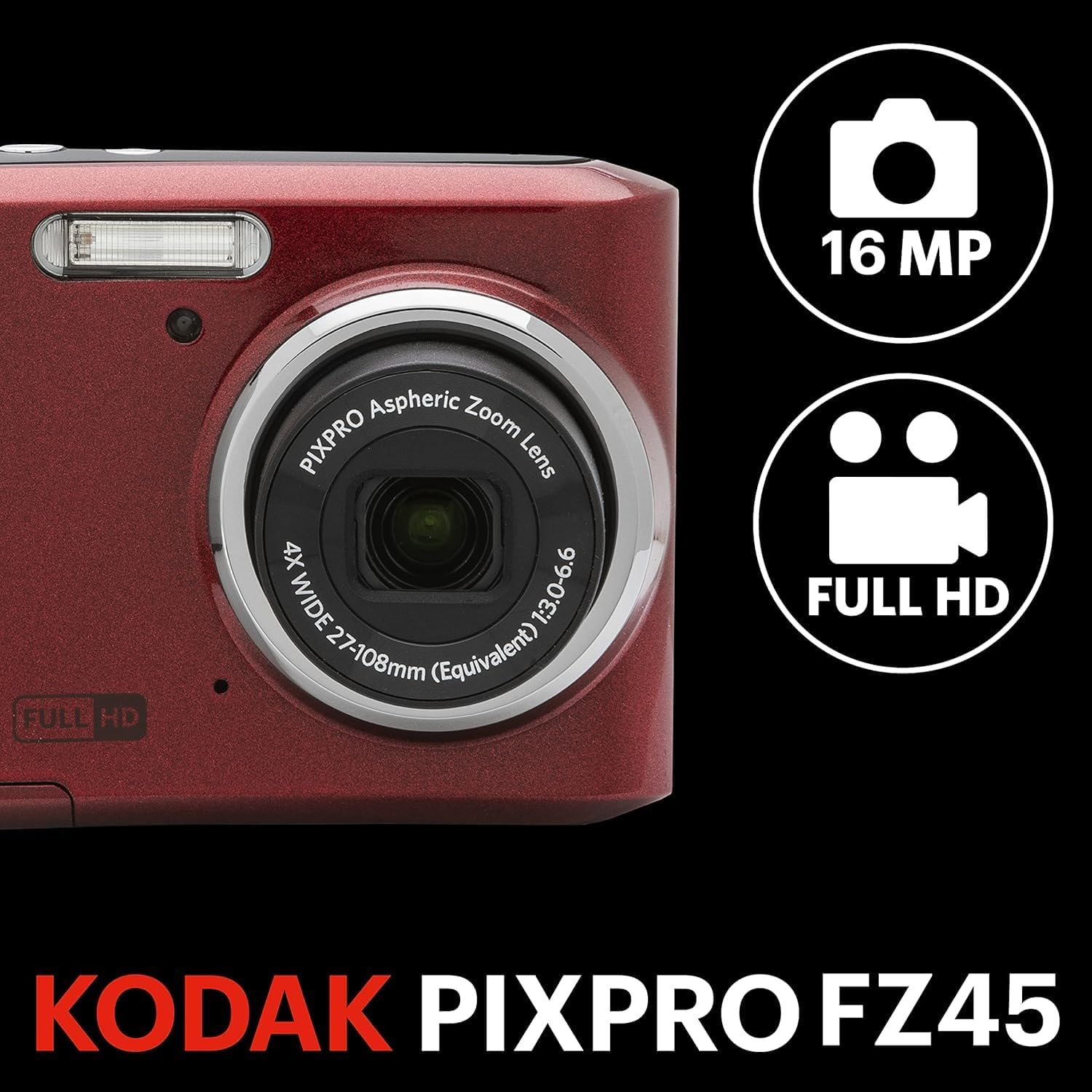
At the heart of the FZ45 lies a 16-megapixel CMOS sensor. In the current landscape, 16MP might appear conservative—flagship phones push 48MP, 50MP, or even 200MP. However, for a 1/2.3-inch class sensor (standard for this category), 16MP represents a sweet spot. It avoids the pitfalls of over-sampling tiny pixels, which often leads to aggressive noise reduction smearing fine detail in low light. Instead, the pixel pitch is large enough to gather reasonable light, producing clean, usable JPEGs straight out of camera for the intended output: 4×6 prints, social media uploads, and viewing on tablets or TVs.
The lens is the optical soul of any fixed-lens camera. The FZ45 employs a 4x optical zoom spanning a 27mm wide-angle equivalent at the wide end. This 27mm focal length is a significant specification. Many budget compacts start at 28mm or even 30mm. That extra millimeter of width makes a tangible difference in practical scenarios: capturing an entire building facade in a narrow European alleyway, fitting a large family reunion group around a dinner table, or establishing a sense of place in a landscape shot without needing to stitch panoramas.
The 4x optical zoom extends this to roughly 108mm equivalent. This is a “standard” zoom range—modest compared to 30x or 50x “travel zoom” behemoths, but optically superior. Long zoom ranges on small sensors almost invariably require slow maximum apertures (f/5.6, f/6.3, f/8 at the tele end), forcing high ISOs and degrading image quality. By restricting the range to 4x, Kodak likely maintains a faster maximum aperture throughout the zoom range (or at least a less severe drop-off), preserving shutter speeds and ISO performance. It is a zoom range designed for photography, not surveillance. It covers the classic “walkaround” focal lengths: 27mm for environment, 35mm/50mm for street and portraits, and 85mm-100mm for tight details or compressing background.
Video Capabilities: 1080p Full HD Pragmatism
The specification lists “1080p Full HD Video.” In a spec sheet world obsessed with 4K, 6K, and 8K, 1080p sounds dated. In a practical usage context for this target user, it is entirely appropriate.
Consider the workflow: A parent records a school play. A traveler captures a street musician. A vlogger needs B-roll for a quick edit. 1080p files are manageable. They write quickly to affordable SD cards, transfer rapidly to older laptops or tablets, and edit smoothly on basic software (or phone apps) without proxy workflows. For viewing on a phone screen, tablet, or even a 55-inch living room TV, 1080p is visually indistinguishable from 4K at normal viewing distances.
Furthermore, the lack of 4K removes the overheating risks and 29-minute recording limits (often imposed by tax classifications on 4K cameras) that plague higher-end bodies. The FZ45 is built for “short clips or school events”—situations where continuous, reliable recording trumps pixel count. The inclusion of a mono microphone (standard for this class) captures ambient audio adequately for memories, though wind noise will be a factor outdoors, as with virtually all cameras lacking a mic jack.
Power Philosophy: The AA Battery Revolution
Perhaps the most polarizing yet brilliant feature of the FZ45 is its power source: two standard AA alkaline batteries. The description explicitly frames this as “convenient power anywhere without charging.”
This design choice is a masterstroke for the specific use cases outlined.
- Travel/Remote Use: On a week-long camping trip, a safari, or a cruise with limited outlet access, a dead rechargeable Li-ion battery renders a camera a paperweight. With the FZ45, a fresh set of AAs from a gas station, airport kiosk, or hotel gift shop restores full functionality in 30 seconds. No power banks, no cables, no waiting.
- Emergency/Infrequent Use: A camera sitting in a glove box or emergency kit for a year will likely have dead Li-ion cells (which self-discharge and degrade). Alkaline AAs have a 10-year shelf life. The camera works the moment you need it.
- Cost of Ownership: Replacement proprietary batteries for older cameras become expensive or unavailable. AAs are a global standard.
The trade-off is weight and capacity. Alkalines have lower energy density than Li-ion and perform poorly in extreme cold (where Lithium AA primaries—Energizer Ultimate Lithium—are a recommended upgrade). However, the spec notes compatibility with AA batteries broadly, implying NiMH rechargeable AAs (Eneloop, etc.) are also viable, offering a “best of both worlds” scenario: rechargeable convenience at home, disposable backup on the road.
Storage and Workflow: Modern Capacity, Classic Media
The FZ45 accepts Class 10 SD, SDHC, and SDXC cards up to 512GB. This is a thoroughly modern specification. Class 10 (U1/V10) guarantees a minimum 10MB/s write speed, perfectly adequate for 16MP JPEGs and 1080p video bitrates. The 512GB ceiling is effectively “unlimited” for this camera; at ~4-6MB per JPEG, that is roughly 80,000+ images. A user could theoretically shoot a two-week vacation on a single 64GB card without offloading.
The workflow remains delightfully analog: shoot -> remove card -> insert into laptop/card reader -> edit/archive. No Wi-Fi pairing failures, no proprietary app updates, no cloud subscription prompts. For the “beginner” or “family” user, this direct file management is often less intimidating than negotiating wireless transfer protocols.
The “Digicam” Aesthetic and Cultural Context
The product title includes the keyword “Digicam.” This is not accidental. There is a growing cultural movement—particularly among Gen Z and younger Millennials—reclaiming the CCD/CMOS compact camera aesthetic of the 2000s and early 2010s. This “digicam” trend values the specific color science, the flash look, the grain structure, and the process of taking a photo on a device that only takes photos.
The FZ45, while a modern CMOS sensor (not the older CCD sensors prized by purists for their specific “bloom” and color), slots neatly into this workflow. It offers the physical ritual: power on, lens extends, half-press shutter, mechanical click. It enforces intentionality. You cannot check email between frames. You cannot doom-scroll while waiting for the bus. You are a photographer holding a camera. For families, this creates a healthy boundary; the device handed to a child at a birthday party is a creative tool, not a portal to YouTube.
Usability and Menu System
The promise of “clear menus” and “no learning curve” is backed by the hardware. Without a touchscreen, the menu navigation relies on the 4-way controller and an OK/Func button. This is the gold standard for reliability. Menus on low-res resistive touchscreens (common on budget cameras of the past) are often frustratingly unresponsive. Physical buttons work 100% of the time, with gloves on, with wet fingers, or in bright sun.
Likely scene modes (Auto, Portrait, Landscape, Sport, Beach, Sunset, etc.) handle the heavy lifting of exposure logic. The “Auto” mode is the hero here—intelligent enough to handle face detection, scene recognition, and flash management so the user doesn’t have to think about f-stops or ISO.
Limitations and Honest Assessment
A review based solely on specifications must also acknowledge the constraints implied by the data.
- Low Light Performance: A 1/2.3″ sensor at 16MP with a slow kit lens (typical max aperture f/3.0 – f/6.5 range) will struggle indoors. The built-in flash will be the primary illuminant for evening family events. High ISO performance (likely topping out at ISO 1600 or 3200 usable) will show noise.
- Speed: Contrast-detect autofocus on budget compacts is not instantaneous. Shutter lag (time between press and capture) and AF acquisition speed will be slower than a modern smartphone. “Sport” mode helps, but this is not an action camera.
- Build Quality: “Slim, lightweight body” usually implies polycarbonate plastic construction. It is not weather-sealed. It is not ruggedized. It requires a wrist strap and care.
- Connectivity: No Wi-Fi, Bluetooth, or GPS. Geotagging requires manual entry later. Sharing requires a card reader or cable.
Verdict: The Right Tool for the Specific Job
The KODAK PIXPRO FZ45 is not a camera for the spec-sheet comparator. It does not win on dynamic range, autofocus speed, video resolution, or sensor size. It wins on frictionlessness.
It solves the “phone problem” for parents: the kid gets a real camera, the parent keeps their phone.
It solves the “charger problem” for travelers: AAs bought at a newsagent in Reykjavik or a bodega in Brooklyn keep the camera alive.
It solves the “complexity problem” for beginners: Real buttons, optical zoom, instant on/off, zero setup.
The 27mm wide-angle lens is the photographic ace up its sleeve, enabling compositions that tighter lenses miss. The 16MP sensor is the responsible choice, prioritizing file manageability and low-light cleanliness over marketing numbers. The 1080p video is the pragmatic choice for editable, shareable clips.
In a market saturated with devices that demand attention, updates, and charging, the KODAK PIXPRO FZ45 stands out by demanding almost nothing. It asks only for two AA batteries and an SD card, and in return, it offers a dedicated, optical, tactile photographic experience. For travel journals, family archives, and the simple joy of a camera that is just a camera, it represents a highly focused, highly functional value proposition. It is a reminder that sometimes, the best camera is the one that gets out of your way.