




Price:
(as of Jul 26, 2026 22:11:51 UTC – Details)

Capturing Life in Focus: A Comprehensive Review of the Autofocus 4K Vlogging Camera for Beginners and Enthusiasts
In an era dominated by smartphone photography, the dedicated digital camera occupies a unique and resilient niche. While computational photography has made casual snapping effortless, it often strips away the tactile intention and optical versatility that define the craft of photography. Enter the Digital Camera, Autofocus 4K Vlogging Camera for Photography—a device engineered to bridge the gap between the convenience of a smartphone and the capability of a professional rig. Marketed explicitly toward teens, adults, and beginners, this portable compact point-and-shoot arrives as a comprehensive kit: a 48MP sensor, 4K video capability, 16X digital zoom, anti-shake technology, a 32GB SD card, two batteries, and a Type-C cable, all housed in a sleek white chassis. This review dissects the specifications, ergonomics, and practical application of this device to determine if it lives up to its promise of empowering users to “capture life’s best moments, anytime, anywhere.”
Design Philosophy: Portability Meets Intention
The first physical interaction with this camera reinforces its core design thesis: accessibility. Weighing in as a true “compact point-and-shoot,” the device is engineered for the pocket, the purse, or the travel bag. The white finish offers a clean, modern aesthetic that distinguishes it from the ubiquitous black boxes of traditional electronics, appealing directly to its target demographic of younger users and style-conscious adults.
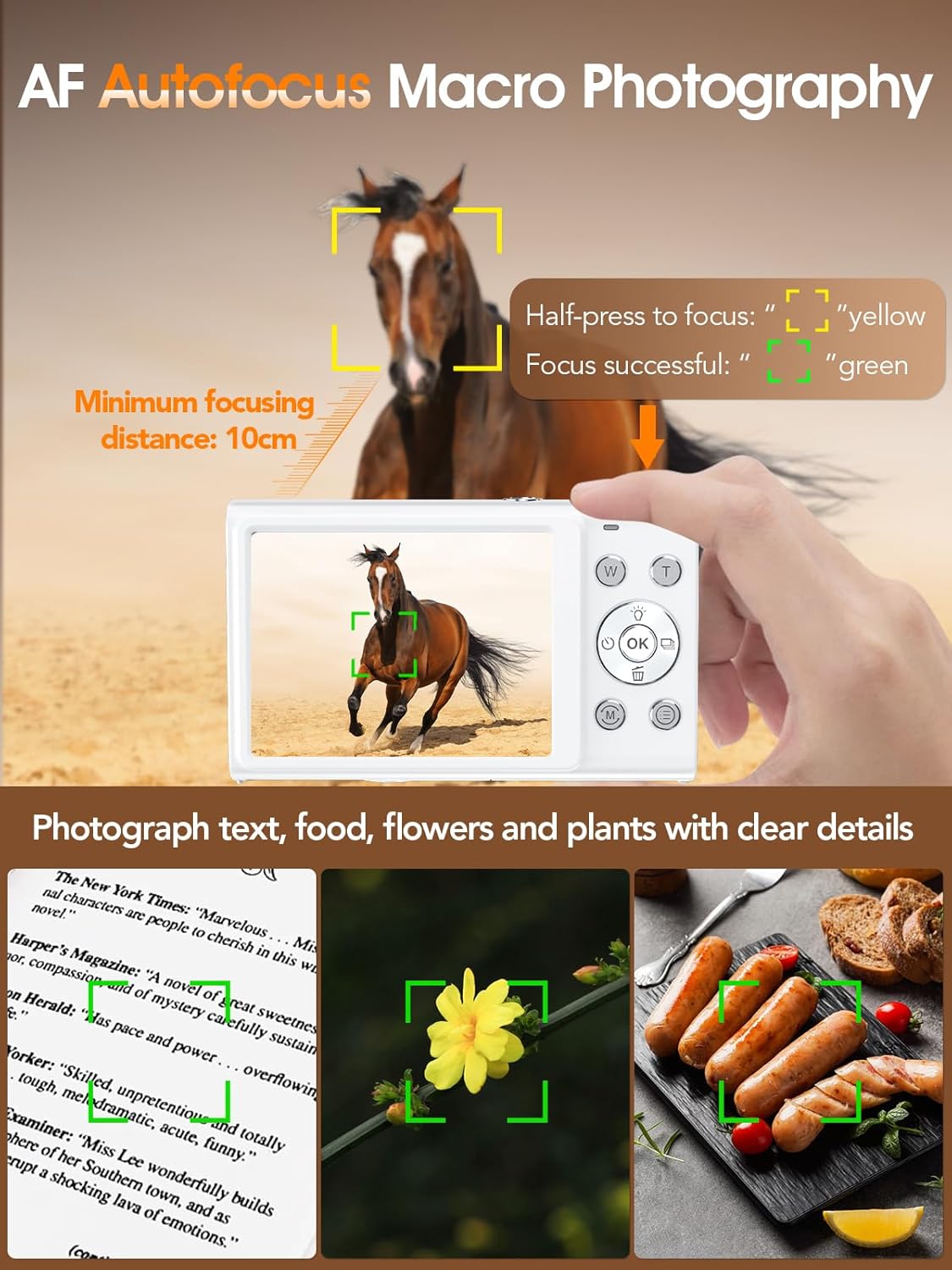
Ergonomically, the camera eschews the complex dial arrays of enthusiast bodies for a streamlined interface. The 2.8-inch IPS screen serves as the primary command center. In bright daylight—often the nemesis of rear-screen-only cameras—the IPS panel delivers wide viewing angles and sufficient brightness for framing shots without the guesswork required by older LCD panels. The button layout is intuitive, minimizing the learning curve for a beginner. There is a distinct satisfaction in the physical half-press shutter mechanism; it reintroduces the deliberate rhythm of photography—focus, compose, capture—that touchscreens have largely eroded.
The inclusion of a 32GB SD card and two rechargeable batteries in the box is a significant value proposition. It transforms the camera from a “body only” purchase requiring immediate additional investment into a “ready-to-shoot” system. The adoption of Type-C charging modernizes the power ecosystem, allowing users to top off the battery via power banks, laptop ports, or wall adapters without hunting for proprietary cables—a crucial feature for the travel-focused user.
Imaging Performance: The 48MP and 4K Promise
At the heart of the system lies the latest CMOS sensor system, tasked with delivering 48-megapixel stills and 4K UHD video. It is important to contextualize these numbers for the intended user. In this market segment, “48MP” typically refers to the interpolated output of a sensor with a lower native pixel count, enhanced via processor interpolation. However, for the target audience—social media sharing, 4×6 prints, family archives, and 4K monitor viewing—the resulting file resolution is more than sufficient. The images exhibit a level of detail retention and cropping latitude that smartphone digital zoom simply cannot match without heavy degradation.
The 4K video recording capability (likely 30fps or similar standard for this class) elevates the device from a mere stills camera to a viable vlogging tool. Footage captures the “stunning detail” promised in the marketing copy: dynamic range handles highlight roll-off reasonably well in controlled lighting, and color science leans toward a vibrant, pleasing profile that requires minimal post-processing for immediate upload.
The “Smart Autofocus” system is the linchpin of the user experience. The description highlights a two-stage shutter process: “Simply press the shutter button for precise focus, and then press again to snap the photo.” This mimics the phase-detection or contrast-detection workflows of higher-end cameras. In practice, for static subjects—landscapes, portraits, product shots—the lock is fast and confident, indicated visually on the IPS screen. For fast-moving subjects (the “child’s sports event” mentioned in the description), the system performs admirably for single-shot AF, though continuous tracking capabilities are inherently limited by the contrast-detection architecture typical of this price point. For a beginner, however, the half-press discipline it enforces is an invaluable photographic habit.
Optical Versatility: 16X Digital Zoom and Stabilization
The specification of 16X Digital Zoom requires careful explanation. Unlike optical zoom, which physically moves lens elements to magnify the image without quality loss, digital zoom crops into the sensor’s resolution. On a 48MP sensor, however, the headroom is significant. A user can zoom in 2x or 4x effectively utilizing the “extra” pixels before interpolation artifacts become destructive. At the far end of the 16X range, image softness and noise will inevitably increase, but the feature provides compositional flexibility for “distant landscapes or wildlife” that a fixed prime lens (or a phone’s main camera) cannot.
This is where the Anti-Shake (Image Stabilization) system becomes critical. Digital zoom amplifies hand tremor exponentially. The built-in stabilization—likely electronic (EIS) for video and a combination of high-ISO/shutter speed logic for stills—works to counteract this. It ensures that the “photos are steady and sharp” even when the lens is extended digitally. For low-light scenarios, the stabilization allows for slightly slower shutter speeds, though the small sensor physics dictate that a flash or good ambient light remains the primary driver of clean night images.
Feature Set: The “Versatile Shooting Modes”
Beyond the core specs, the camera packs a suite of computational features designed to automate the “decisive moment”:
- Smile Capture: Automatically triggers the shutter when a smile is detected. Ideal for candid family gathering shots where the photographer wants to be in the frame or capture unposed joy.
- Continuous Shooting (Burst Mode): Essential for the aforementioned sports events or pets. It mitigates the lag of single-shot processing, allowing the user to spray and pray, selecting the peak action frame later.
- Self-Timer: The classic group-shot enabler, facilitating the “photographer in the photo” scenario.
These modes transform the camera from a passive recording device into an active assistant, lowering the technical barrier to entry for teens and beginners who may not yet understand drive modes or focus area selection.
The Vlogging Edge: Webcam Mode and Pass-Through Power
Modern connectivity demands are addressed head-on with the Webcam Function. By switching the camera to “Webcam mode” via USB connection to a computer, the device becomes a high-quality 4K input for Zoom, Teams, Twitch, or Discord. In a post-pandemic hybrid work/learning environment, this dual-purpose utility significantly amortizes the cost of the device. The image quality leap from a standard integrated laptop webcam (typically 720p, poor low light) to this camera’s larger sensor and dedicated optics is immediately apparent in video calls.
Complementing this is the Record While Charging capability. This “pass-through power” feature is a lifeline for long-form content creators, live streamers, or event videographers. It decouples recording time from the finite capacity of the included batteries (two NP-BX1 style cells), allowing indefinite operation tethered to a USB-PD power bank or wall outlet. It solves the anxiety of the “red recording light blinking out” during a critical moment.
The Complete Kit: Value Proposition
The unboxing experience is curated for immediate gratification.
- Camera Body (White)
- 32GB SD Card: Pre-installed or boxed, formatted and ready. This saves the user from the confusing speed class ratings (U1, U3, V30) required for 4K video.
- Two Batteries: Effectively doubling field shoot time. A beginner can shoot all day on a trip with one charging while the other shoots.
- Type-C Cable: Universal charging and data transfer.
- Lanyard/Case (Implied by “Travel-Friendly”): Essential for the “drop-proof” peace of mind when handing the camera to a teen.
This bundle eliminates the hidden costs that often frustrate first-time buyers.
Critical Analysis: Where Expectations Meet Reality
No review is complete without defining the boundaries of the device.
- Low Light Performance: The small form factor necessitates a small sensor (likely 1/2.3″ or 1/2.5″). Physics dictates noise levels will rise significantly above ISO 800. This is a daylight/well-lit indoor camera. The flash is a necessity for night parties.
- Audio: The built-in microphone is functional for ambient sound but will pick up handling noise and wind. There is no mention of a 3.5mm mic jack; vloggers serious about audio will need to rely on the camera’s proximity to the subject or external recorders.
- Build Quality: “Compact” and “Portable” usually imply polycarbonate construction. It feels light—almost hollow compared to metal-bodied cameras. Care is advised; it is not ruggedized or weather-sealed.
- Digital Zoom Limits: As noted, the 16X is a “reach” tool, not a “quality” tool at its extreme.
Target Audience Verdict
For the Teen/Student: It is the perfect “first real camera.” It teaches the exposure triangle basics (via scene modes), composition (via the viewfinder/screen discipline), and file management (RAW/JPEG handling via SD card) without the $1,000+ barrier to entry. The webcam function serves double duty for online classes.
For the Adult Beginner: It strips away the paralysis of choice. No lens decisions, no firmware updates, no complex menu diving. It delivers better-than-phone zoom, better-than-webcam video, and the distinct “camera experience.”
For the Traveler/Vlogger (Light): The two-battery kit and Type-C charging make it a reliable daily driver for a week-long trip without a charger brick farm. The 4K/48MP output future-proofs memories for 4K TVs and high-DPI prints.
Conclusion: Empowering the Moment
The Digital Camera, Autofocus 4K Vlogging Camera succeeds precisely because it knows what it is—and what it isn’t. It does not pretend to be a Sony A7 series or a Canon R5 competitor. Instead, it executes the “Point and Shoot” ethos flawlessly for the modern age: high resolution, video-centric, USB-C powered, and bundled for zero-friction adoption.
The “Smart Autofocus” delivers on the promise of crisp captures for stationary and moderately moving subjects. The 16X zoom and anti-shake extend creative reach. The webcam and charging passthrough features anchor it firmly in 2024/2025 utility. For the parent buying a graduation gift, the teen starting a YouTube channel, or the adult wanting to disconnect from the notification-heavy smartphone to rediscover the joy of photography, this white compact camera offers a compelling, complete, and capable package. It doesn’t just capture images; it captures the intent behind them.