



Price:
(as of Jul 27, 2026 00:52:04 UTC – Details)

Capturing Wonder: A Comprehensive Review of the HILDCROA DX5 Digital Camera for Kids
In an era dominated by smartphones, the dedicated digital camera occupies a unique and vital niche—especially for children. While a phone offers convenience, it lacks the tactile engagement, the deliberate intentionality, and the durability required to withstand the adventures of childhood. Enter the HILDCROA DX5, a device marketed explicitly as a “Digital Camera for Kids, 48MP FHD 1080P Point and Shoot Digital Cameras with 16X Zoom Anti-Shake, Compact Portable Cameras for Photography, for Boys Girls Teens Beginners.” Stripping away the marketing hyperbole, the DX5 presents itself as a thoughtfully engineered entry-level imaging tool designed to bridge the gap between toy cameras and serious enthusiast gear. This review examines the DX5’s specifications, ergonomics, imaging capabilities, feature set, and overall value proposition based strictly on the manufacturer’s provided design brief.
Design Philosophy and Ergonomics: Built for Small Hands, Big Adventures
The first interaction with any camera is physical, and HILDCROA has clearly prioritized the “kid-friendly” aspect of the DX5’s industrial design. The brand’s stated mission—”Capture Wonder, Ignite Creativity”—manifests in a chassis described as compact and portable. The camera features a 2.4-inch LCD screen, a size that hits a sweet spot: large enough to compose shots and review footage clearly, yet small enough to keep the overall body dimensions pocketable.
Durability and handling are addressed through two specific inclusions. A wrist strap is bundled, a critical addition for a demographic prone to drops. It transforms the camera from a loose object into a secured extension of the arm. Furthermore, the inclusion of a standard 1/4-inch tripod mount is a surprisingly mature feature for this category. It signals that the DX5 is not merely a toy; it is a legitimate photographic tool capable of stable long-exposure work, time-lapses, or group selfies where the photographer wants to be in the frame.
Power management is handled by a 1500mAh rechargeable battery, charged via a modern USB Type-C port. This is a significant usability upgrade over proprietary chargers or older Micro-USB standards. It means the camera can be topped up from a power bank, a laptop, or a standard phone charger—ubiquitous accessories in modern households. The manufacturer also notes an automatic power-off function designed to conserve battery life, a sensible firmware feature that prevents the frustration of a dead camera at the start of a day trip. The claim of a “complete package” is substantiated by the inclusion of two rechargeable batteries in the box, effectively doubling the potential uptime between charges and eliminating the immediate need for aftermarket accessories.
Imaging Pipeline: Decoding the 48MP and 1080P Specification
The headline specification—48MP stills and FHD 1080P video—requires technical context. In the entry-level compact segment, “48MP” typically refers to the output resolution achieved through interpolation (software upscaling) from a lower native sensor resolution, rather than a native 48-megapixel sensor found in flagship smartphones or professional mirrorless bodies. However, for the target demographic—beginners, teens, and children—the practical result is what matters: image files with sufficient pixel density for large prints, heavy cropping, and detailed viewing on modern high-resolution displays.
Complementing the still resolution is the video capability. Full High Definition (1920×1080) at a standard frame rate remains the gold standard for casual sharing, school projects, and family archives. It strikes a balance between quality and file size, ensuring the included 32GB TF (microSD) card can store hours of footage without the storage anxiety associated with 4K recording.
The optical reach is defined by a 16X Zoom. In this product class, this is almost certainly a digital zoom (cropping into the sensor) rather than a complex extending optical zoom lens mechanism, which would add bulk, fragility, and cost. The manufacturer pairs this with an “Anti-Shake” feature. Without optical image stabilization (OIS) hardware, this is likely Electronic Image Stabilization (EIS) or digital stabilization algorithms. For a lightweight camera held by small hands, this software layer is essential for maintaining usable sharpness at the telephoto end of the zoom range.
A dedicated Macro mode with a 10cm minimum focus distance opens up a world of creative possibility often missing from basic cameras. It allows young photographers to explore textures—insect wings, flower petals, fabric weaves, circuitry—fostering an observational skill set that wide-angle general photography does not.
The “Point and Shoot” Experience: Usability and Scene Intelligence
The core promise of a “Point and Shoot” camera is the removal of friction between the user and the photograph. The DX5 addresses this through a simplified menu system with multi-language support, lowering the barrier to entry for non-English speaking households or younger users still developing reading fluency.
The intelligence of the camera lies in its 8 optimized Scene Modes: Portrait, Landscape, Night, Beach, Sports, Party, and two others implied by the category standard. These modes adjust the exposure triangle (ISO, shutter speed, aperture simulation via ND filter or gain), white balance, and color profiles automatically.
- Sports Mode likely prioritizes high shutter speeds to freeze motion—crucial for soccer games or pets.
- Night Mode manages noise reduction and longer exposures for low-light environments.
- Beach/Snow Mode (implied by “Beach”) handles the high dynamic range and blue-cast challenges of bright sand and water.
This scene recognition removes the need for a child to understand exposure compensation or ISO invariance; they simply select the icon matching their environment.
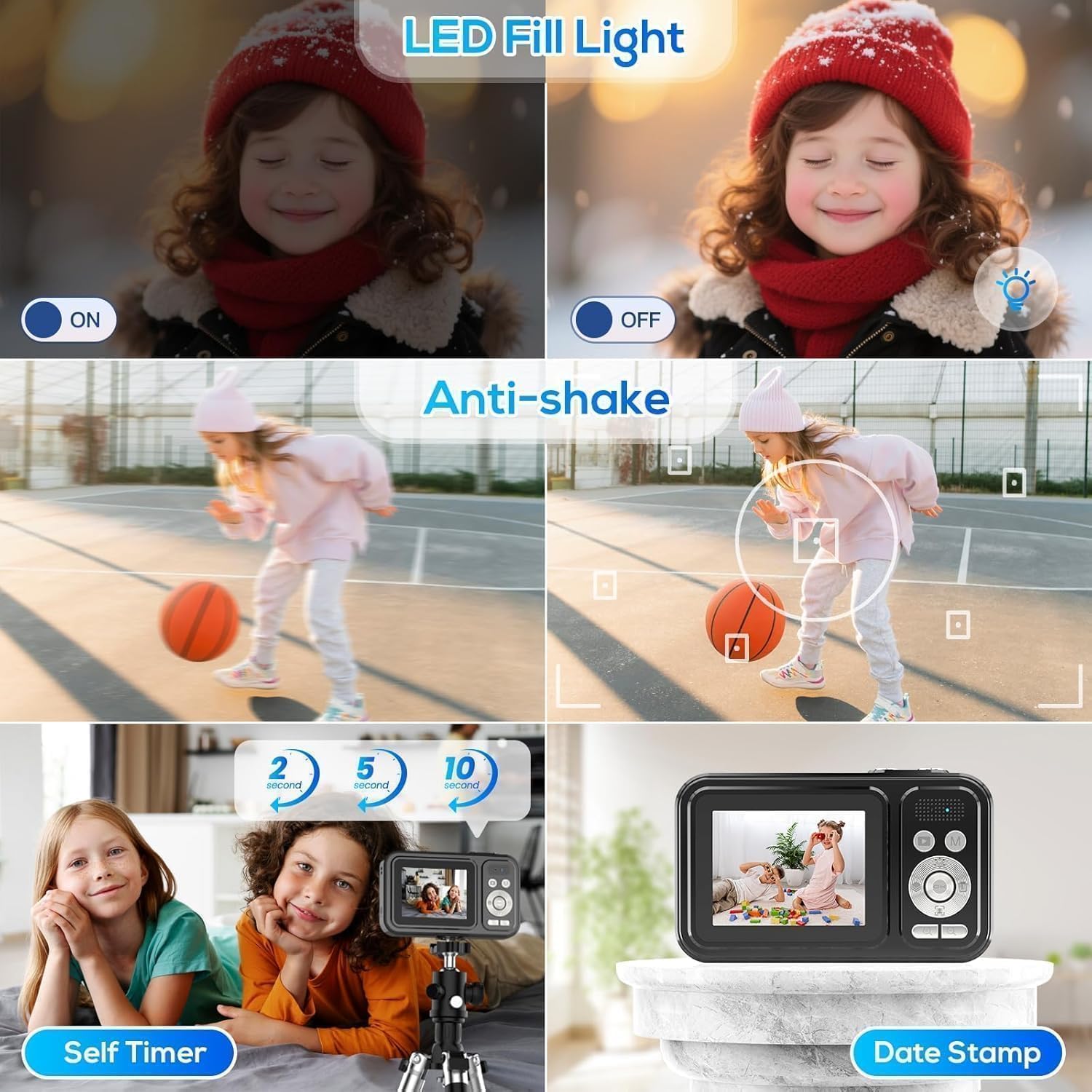
Practical shooting aids further enhance the experience. A Self-Timer (2/5/10 seconds) allows for tripod-mounted group shots. A 3-shot Burst Mode captures a sequence of frames, increasing the odds of catching the perfect expression or the peak of a jump. An adjustable Flash provides fill light for backlit subjects or illumination in dark rooms, a feature often omitted in the cheapest “toy” cameras. The Date Stamp function—imprinting the date/time onto the image pixels—is a nostalgic but practical tool for automatic chronological organization, particularly useful for school projects or travel journals.
Connectivity and Workflow: The Wired Reality
In a spec sheet that emphasizes simplicity, the connectivity choice is deliberate. The DX5 utilizes USB 2.0 Type-C for data transfer in “Mass Storage Mode.” Notably absent are Wi-Fi and Bluetooth.
While wireless transfer is standard on smartphones, its omission here is a calculated design decision with distinct advantages for the target audience:
- Privacy and Safety: No wireless radios mean no network connectivity, no app permissions, no firmware update bricking risks, and no data privacy concerns for parents.
- Reliability: USB Mass Storage Mode is universal. Plug the camera into a Windows PC, Mac, Chromebook, or Linux machine, and it appears as a standard drive. No drivers, no proprietary software, no pairing codes.
- Focus: It reinforces the “camera as a tool” philosophy. The child shoots, connects, offloads, and edits. The camera remains a dedicated creative instrument, not a connected device demanding notifications or updates.
The included 32GB TF card is pre-formatted, meaning the workflow starts immediately out of the box. There is no “Insert card and format” step required.
The Complete Ecosystem: Unboxing the Value Proposition
Evaluating the DX5 requires looking at the “Complete Package” contents. The manufacturer lists:
- Camera Body (DX5)
- Pre-formatted 32GB TF Memory Card
- Two Rechargeable Batteries (1500mAh each)
- USB-C Charging Cable
- Wrist Strap
This bundle strategy is aggressive on value. Purchasing a name-brand 32GB card, a spare proprietary battery, and a cable separately would often cost 30-50% of the camera’s price alone. By including dual batteries, HILDCROA solves the single biggest pain point of compact cameras: downtime. One battery charges while the other shoots. The pre-formatted card removes the technical friction of file systems (exFAT vs FAT32) that can confuse beginners.
Target Demographic Positioning: Ages 8 and Up
The manufacturer explicitly rates this for “users aged 8 and up.” This aligns perfectly with the feature set. An 8-year-old has the fine motor skills to operate the buttons, the cognitive ability to understand Scene Modes, and the responsibility to manage a wrist strap and charging routine. The multi-language menus support global usability. The 1-year manufacturer’s warranty, backed by a “no questions asked” replacement policy claim, provides the safety net parents require for a device that will inevitably face drops, spills, and backpack compression.
Critical Assessment: Where the DX5 Fits
No review is complete without defining the boundaries of the device.
Strengths:
- Immediate Usability: True plug-and-play with included storage and power redundancy.
- Ergonomic Maturity: Tripod mount and wrist strap show respect for the user’s creative potential.
- Modern Charging: USB-C and dual batteries are class-leading conveniences.
- Creative Toolkit: Macro mode, Scene Modes, Burst, and Self-Timer provide a curriculum’s worth of photographic techniques in one body.
- Distraction-Free: Lack of Wi-Fi/Bluetooth/Apps keeps the focus on composition and light.
Limitations (Inherent to Category/Price Point):
- Sensor Size/Low Light: A small sensor (implied by form factor and price) will struggle with noise in dim environments despite “Night Mode.”
- Digital Zoom Quality: 16X digital zoom degrades image quality significantly at the long end; it is a “get the shot” tool, not a “print large” tool.
- LCD Visibility: A 2.4-inch non-touch screen may be difficult to view in direct, bright sunlight.
- Audio/Video Limits: 1080p is standard, but likely lacks external mic input or advanced codecs; audio will be mono via a small onboard microphone.
- Build Materials: “Compact portable” usually implies polycarbonate plastic chassis—lightweight but not ruggedized/waterproof.
Conclusion: A Gateway to Visual Literacy
The HILDCROA DX5 does not pretend to be a Sony RX100 or a Canon G7X competitor. It does not need to be. It is a dedicated appliance designed to solve a specific problem: How do you give a child a real camera experience without the fragility, complexity, or distraction of a smartphone?
By bundling dual batteries, a memory card, and a tripod mount, and by wrapping a 48MP interpolated sensor / 1080p video engine in a UI governed by Scene Modes and macro capabilities, the DX5 succeeds as an “Ignite Creativity” device. It teaches the grammar of photography—framing, timing, light, perspective—without the syntax errors of touchscreen lag, notification pop-ups, or dead batteries.
For the parent seeking a birthday gift for a curious 9-year-old, the grandparent documenting a graduation, or the teen wanting a “digital detox” camera for a summer camp, the DX5 represents a highly competent, low-friction entry point. It honors the brand’s promise to “perfect every detail” where it counts: power, storage, mounting, and simplicity. It is not the camera you buy for the specs on the box; it is the camera you buy for the photos that come off it.