




Price: $2,599.00
(as of Jul 28, 2026 20:17:21 UTC – Details)

Sony Cyber-Shot DSC-RX1 RII Digital Still Camera, Black: A Comprehensive Product Review
Introduction
The Sony Cyber-Shot DSC-RX1 RII stands as one of the most impressive compact digital still cameras ever engineered by Sony. Positioned squarely in the premium segment of fixed-lens cameras, the DSC-RX1 RII is designed for photographers who demand the image quality and creative flexibility of a full-frame DSLR, wrapped inside a remarkably portable and unobtrusive body. With its black finish lending it a refined, professional aesthetic, this camera represents the second generation of Sony’s celebrated RX1 line, incorporating a suite of technological advancements that elevate it above its predecessor and establish it as a serious contender among full-frame compact cameras.
Sensor: A 42.4MP Full-Frame Powerhouse
At the heart of the DSC-RX1 RII lies a 42.4-megapixel full-frame back-illuminated Exmor R CMOS sensor. This sensor is a significant leap in imaging capability, delivering extraordinary resolution that allows photographers to capture fine detail with remarkable precision. The back-illuminated design of the Exmor R sensor is a critical advancement in sensor architecture. By repositioning the wiring layers behind the photodiode layer, the sensor gains improved light-gathering efficiency, resulting in reduced noise and enhanced sensitivity even in challenging lighting conditions. With a maximum ISO sensitivity extending up to ISO 102,400, the DSC-RX1 RII is capable of producing usable images in extremely low-light environments, making it equally suited for studio work, event photography, and nighttime shooting.
The generous pixel count of 42.4 megapixels provides ample resolution for large-format printing and extensive cropping flexibility, giving photographers substantial creative latitude in post-production. The sheer density of pixels on the full-frame sensor ensures that the resulting images carry a depth of tonal gradation and color accuracy that far exceeds what is typically achievable with smaller sensor formats.
The Lens: ZEISS Sonnar T with Macro Capability
The DSC-RX1 RII is fitted with a fixed 35mm F2.0 ZEISS Sonnar T lens, a partnership that brings Carl Zeiss’s celebrated optical engineering to Sony’s digital imaging platform. The Sonnar T lens design is renowned for its sharp rendering, pleasing bokeh, and well-corrected optical aberrations, and this iteration is no exception. The F2.0 maximum aperture ensures excellent low-light performance and allows for a shallow depth of field that can isolate subjects with beautiful background separation.
What distinguishes this lens further is its macro capability, an addition that expands its versatility considerably. Photographers can move close to subjects and achieve sharp, detailed macro-style imagery, opening up opportunities in nature photography, product shots, and creative close-up work. The fixed nature of the lens is not a limitation but rather a deliberate design choice. By eliminating the need for multiple lens elements and optical groups, the fixed lens allows the camera’s lens and sensor to be aligned at the micron level with remarkable precision. This tight alignment ensures optimal optical performance across the entire image field, contributing to the exceptional sharpness and consistency that the camera delivers from corner to corner.
World’s First User-Selectable Optical Variable Low-Pass Filter
One of the most distinctive and innovative features of the DSC-RX1 RII is the world’s first user-selectable optical variable low-pass filter. Traditional low-pass filters are designed to reduce moiré and false color artifacts that can occur when a camera’s sensor resolution approaches or exceeds the resolving power of the lens. However, these filters inevitably introduce a subtle degree of softness to the image, which can be a trade-off that photographers are unwilling to make when they have invested in a 42.4-megapixel full-frame sensor.
The DSC-RX1 RII addresses this dilemma head-on by giving the photographer the ability to select between two filtering modes. When the camera is set to apply a low-pass filter, moiré and color aliasing are suppressed, resulting in clean, artifact-free images. When the filter is bypassed or set to a reduced intensity mode, the system allows the native sharpness and resolving power of the lens and sensor combination to shine through unencumbered. This dual configuration provides photographers with the flexibility to choose the optimal imaging approach depending on the subject matter and shooting scenario, without needing to change any physical filters or accessories.
Autofocus: Fast Hybrid AF with 399 Phase-Detection Points
The DSC-RX1 RII employs a sophisticated Fast Hybrid AF system that incorporates 399 focal plane phase-detection AF points. This dense array of phase-detection sensors covers a wide area of the image field, enabling the camera to achieve remarkably fast and accurate autofocus acquisition and tracking. Phase-detection autofocus works by splitting incoming light into paired images and comparing them to determine the direction and magnitude of focus error, allowing the lens to move directly to the correct focus position rather than relying on the slower contrast-detection method. With 399 dedicated phase-detection points at the sensor plane, the autofocus system can lock onto subjects quickly and maintain focus reliably even during continuous shooting. This capability is particularly valuable for photographing moving subjects or for capturing decisive moments in street and documentary photography.
Viewfinder and Display
Visual composition is facilitated by the camera’s retractable 2.4-million dot XGA OLED Tru-Finder, which features ZEISS T coating on its optical surfaces. The Tru-Finder delivers a bright, high-contrast view of the scene with smooth motion and accurate color reproduction. The retractable mechanism allows the viewfinder to be folded away when not in use, making the camera compact and portable. The ZEISS T coating minimizes reflections and ghosting within the viewfinder, ensuring a clear sight picture even in bright ambient light. Additionally, the viewfinder supports a diopter adjustment range of -4.0 to +3.0 m⁻¹, accommodating a wide range of eyesight prescriptions and ensuring comfortable viewing for virtually all users.
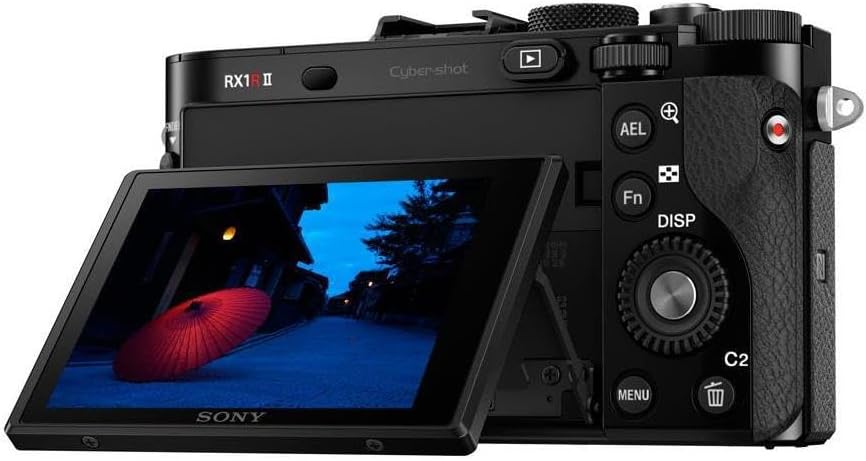
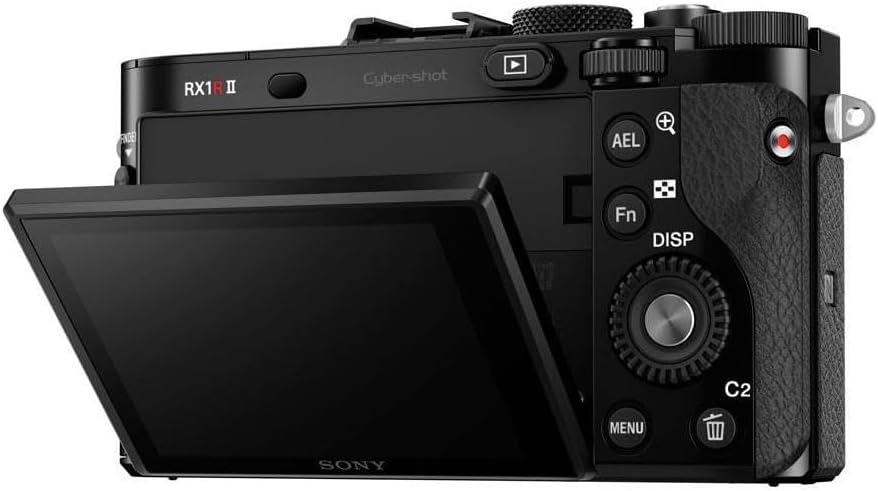
On the rear of the camera sits a tiltable 3-inch (approximately 1,229k dots) Xtra Fine LCD display. The Xtra Fine designation reflects its high-resolution capabilities, providing a vivid and detailed preview of compositions and playback of captured images. The tilting mechanism allows the screen to be adjusted to various angles, which is particularly useful for shooting from high or low positions. Whether the photographer is working at ground level for creative low-angle perspectives or positioning the camera above shoulder height for discreet street photography, the adjustable display offers practical convenience and ergonomic flexibility.
RAW Image Quality and Bit Depth
The DSC-RX1 RII offers users the choice between compressed and uncompressed 14-bit RAW still image capture. At 14 bits, each color channel possesses 16,384 levels of tonal information, providing an extraordinarily wide dynamic range and ensuring that subtle gradations in highlight and shadow are preserved in the raw data. This level of bit depth is particularly valuable for landscape photographers and those working in high-contrast lighting scenarios where preserving detail in both bright skies and deep shadows is essential.
The option for uncompressed RAW output ensures that no data is lost during the compression process, providing the maximum amount of information for post-processing and editing workflows. Professionals who work extensively in image editing software such as Adobe Lightroom, Capture One, or Sony’s own imaging software will appreciate the headroom and flexibility that uncompressed 14-bit RAW files provide. The compressed RAW option, conversely, offers a sensible middle ground for photographers who require the benefits of RAW processing but need to manage file sizes more efficiently, particularly when shooting in large volumes.
Connectivity: Seamless Smartphone Integration
Contemporary photography increasingly demands seamless integration between cameras and mobile devices, and the DSC-RX1 RII delivers in this regard as well. Through built-in Wi-Fi and NFC connectivity, the camera enables simple and immediate image transfer to compatible smartphones via dedicated camera applications. NFC (Near Field Communication) technology simplifies the pairing process — users need only tap their smartphone against the camera to establish a connection, after which image sharing and remote control functions become available through the companion app. Wi-Fi extends this functionality by supporting broader network connectivity, enabling remote shooting, image transfer over greater distances, and integration with cloud-based storage and sharing services.
Conclusion
The Sony Cyber-Shot DSC-RX1 RII represents the convergence of optical excellence, sensor technology, and intelligent engineering in a compact, fixed-lens package. With its 42.4-megapixel full-frame Exmor R CMOS sensor, the ZEISS Sonnar T lens with macro capability, the innovative user-selectable optical variable low-pass filter, the robust Fast Hybrid AF system, and the refined OLED viewfinder with Xtra Fine LCD display, this camera offers a comprehensive imaging solution that rivals dedicated full-frame interchangeable-lens systems in image quality while maintaining the simplicity and portability that a fixed-lens design provides. For photographers seeking a premium, ready-to-shoot full-frame compact camera with uncompromising resolution and advanced features, the DSC-RX1 RII stands as a compelling and authoritative choice.