



Price:
(as of Jul 28, 2026 15:21:30 UTC – Details)

Canon EOS R5 C Mirrorless Camera: A Hybrid Powerhouse Redefining Creative Versatility
Introduction
The Canon EOS R5 C represents a compelling entry in the growing category of hybrid cinema cameras — devices designed to bridge the gap between professional video production and advanced still photography. As a body-only offering, this camera targets filmmakers, multimedia journalists, and technically advanced hobbyists who demand 8K video capability, high-resolution still image capture, and a compact form factor that does not compromise on professional connectivity. Built on the foundation of Canon’s acclaimed EOS R5 still photography platform yet enhanced with a dedicated cinema-grade video feature set, the EOS R5 C occupies a unique niche that warrants a closer look at its specifications, capabilities, and overall package.
Design and Ergonomics
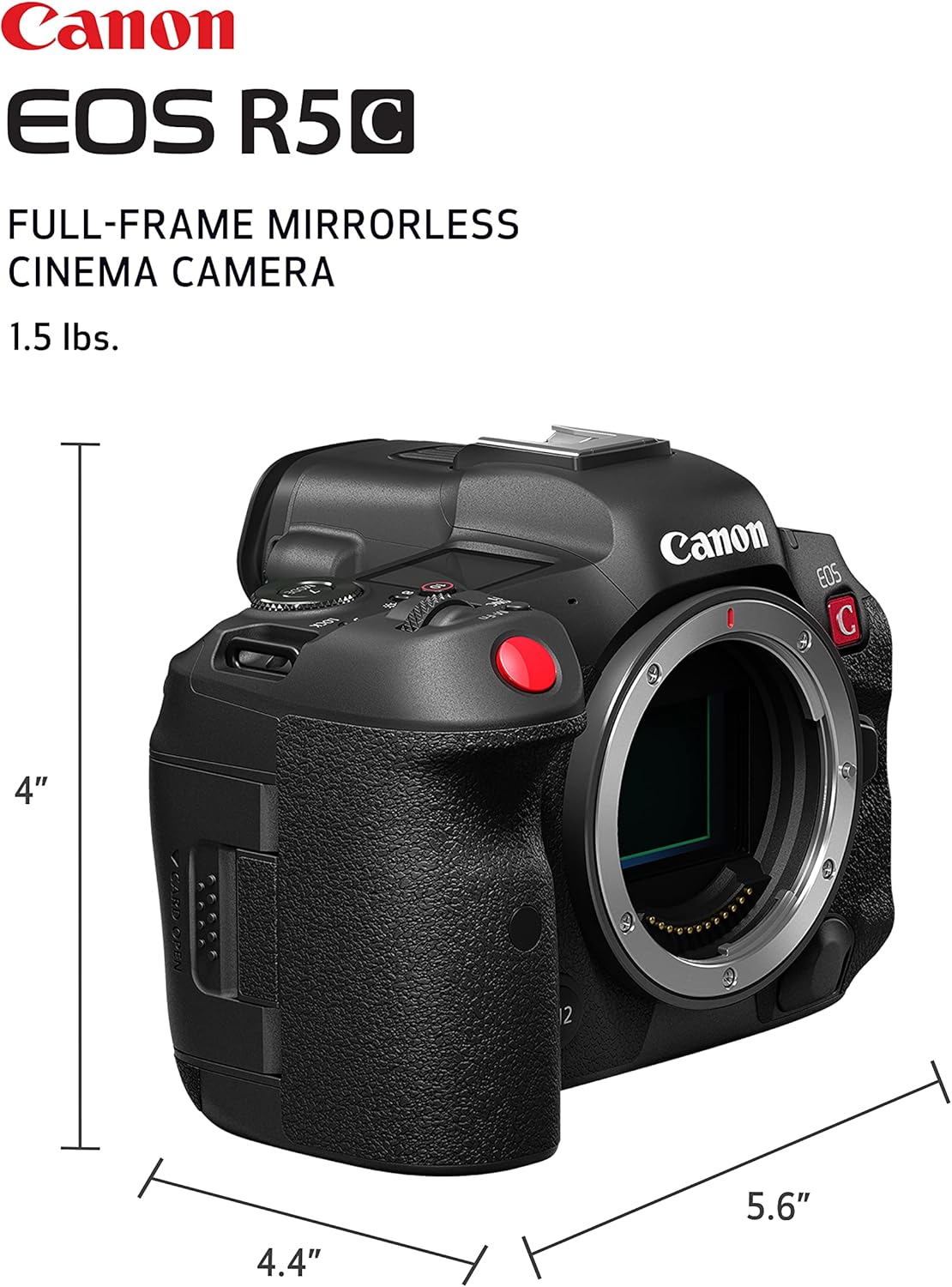
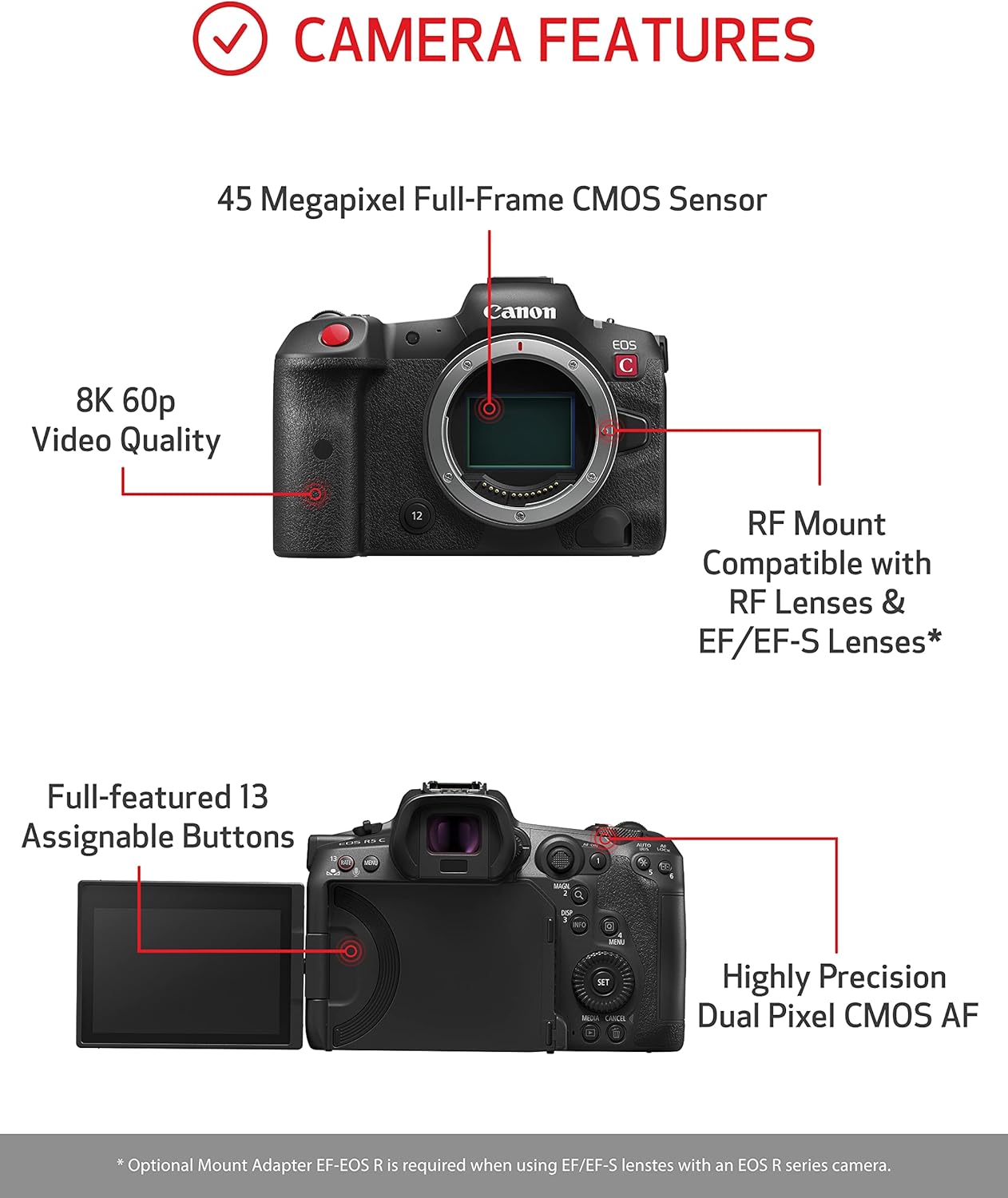
One of the most immediately noticeable aspects of the EOS R5 C is its compact and lightweight body. Canon has engineered this camera with portability in mind, ensuring that it fits comfortably in the hand during extended shooting sessions whether the user is capturing still images or recording motion pictures. The optically extended electronic viewfinder delivers a clear, bright viewing experience, contributing significantly to the overall usability of the system when composing shots in the field. The ergonomic design philosophy extends to the camera’s interface layout as well, with 13 marked, assignable buttons that allow professionals to customize operational controls to match their specific shooting workflows and production requirements.
Imaging Sensor and Still Photography Performance
At the heart of the EOS R5 C lies a 45-megapixel full-frame CMOS sensor — the same class of imaging device found in Canon’s flagship still photography offerings. This high-resolution sensor is responsible for producing remarkably detailed still images with outstanding dynamic range and color fidelity. The DIGIC X image processor works in tandem with the sensor to deliver crisp, vibrant photography with fast continuous shooting speeds. When equipped with a mechanical shutter, the camera achieves up to 12 frames per second, making it capable of freezing fast-moving subjects with precision. For situations demanding even higher burst rates, the electronic shutter extends continuous capture to up to 20 frames per second, an impressive figure for a fixed-mirrorless system. The mechanical shutter speeds reach up to 1/8000 of a second, enabling crisp image capture in bright outdoor environments where traditional electronic shutter approaches might introduce artifacts.
The ISO range of the sensor spans from 100 to 51,200 natively, with expansion capability reaching 102,400. This broad sensitivity range ensures that the camera can perform across a diverse set of lighting environments, from bright daylight conditions to dimly lit interiors — a significant advantage for both still and video work.
Video Capabilities
The EOS R5 C truly distinguishes itself in the video department, offering a suite of professional-grade recording formats that rival dedicated cinema cameras. The system supports internal recording of 8K RAW video at 60 frames per second, delivering cinematic image quality with 16 times the resolution of standard Full HD footage. This 8K capability is paired with High Dynamic Range recording support in both Hybrid Log Gamma (HLG) and Perceptual Quantization (PQ) formats, giving cinematographers extensive latitude in color grading and post-production workflows.
For productions that do not require the full bandwidth of 8K, the camera offers high-quality 4K, 2K, and Full HD recording options. Notably, the 4K and 2K oversampling technology captures 4:2:2 10-bit video by processing data from the full sensor area and downsampling, which effectively reduces moiré patterns, false color banding, and noise in the final output. The camera also supports High Frame Rate (HFR) recording at up to 120 frames per second at 4K resolution in 4:2:2 10-bit color space, and critically, this oversampling is achieved without cropping the sensor — preserving the full wide-angle field of view — a feature invaluable when shooting action sequences, gimbal-mounted footage, or aerial drone cinematography.
Multiple recording formats are available to accommodate different production pipelines. The camera supports MXF-based XF-AVC, which conforms to established broadcasting standards, as well as MP4 for more streamlined delivery workflows. An especially noteworthy feature is the ability to simultaneously record two independent video files with different codecs or resolutions, a capability that caters to professional productions requiring both high-resolution masters and lighter proxy files for same-day editing.
Autofocus System
The EOS R5 C benefits from Canon’s Dual Pixel CMOS AF II technology, which leverages every pixel on the imaging sensor not only for image capture but also for phase-detection autofocus. This system delivers remarkably high-precision focusing that works across both still and video modes. The autofocus coverage encompasses 1,053 automatic AF zones across the frame, providing extensive coverage and ensuring that subjects remain tack-sharp regardless of their position in the composition.
The advanced subject detection algorithms extend to human subjects through Eye, Face, and Head Detection AF, which continuously track and maintain focus on eyes and facial features even during active movement. Beyond human subjects, the system includes Animal Detection AF that can identify and track the eyes, faces, and entire bodies of cats, dogs, and birds — a feature that opens creative possibilities for wildlife and nature videographers. Vehicle subject detection is another noteworthy addition, enabling accurate and reliable tracking of moving cars and motorcycles, which proves useful for automotive coverage, documentary work, and action sequence videography. Touch AF functionality, combined with an 8-way multi-controller, allows users to manually position the autofocus point by simply tapping the LCD screen or using the controller for precise adjustments.
Thermal Management and Continuous Recording
A persistent concern among high-resolution video cameras has always been the thermal limit of internal recording, particularly during prolonged sessions of demanding formats like 8K/60P. Canon has addressed this challenge on the EOS R5 C by integrating a camera body-mounted internal cooling fan that vents internal heat, enabling continuous high-definition recording without interruption or thermal shutdown. This non-stop recording capability is a critical feature for run-and-gun documentary work, live-streaming events, and multi-hour video productions where reliability cannot be compromised by thermal limits.
Professional Connectivity
For productions requiring synchronized multi-camera setups, the EOS R5 C provides a comprehensive timecode input/output terminal, enabling seamless synchronization with other cinema cameras and external devices. This feature, combined with the 13 customizable function buttons and the camera’s ability to record in broadcast-standard formats like XF-AVC, positions the EOS R5 C as a credible tool for professional video production environments ranging from broadcast news gathering to scripted filmmaking.
Package Contents
The EOS R5 C arrives in a well-considered package that includes the digital cinema camera body, a Battery Pack LP-E6NH for extended power endurance, a Battery Charger LC-E6 for reliable replenishment, a Shoulder Strap SS-1200 for comfortable transport, an Interface Cable IFC-100U for data and connectivity purposes, a Cable Protector for longevity, and a Camera Cover R-F-5 for added protection during transportation. This comprehensive inclusion of accessories demonstrates Canon’s commitment to providing a complete out-of-the-box experience without requiring immediate additional purchases.
Operating Parameters
The camera is rated for operation across a temperature range of 0 degrees Celsius to 40 degrees Celsius (32 degrees Fahrenheit to 104 degrees Fahrenheit), making it suitable for a wide variety of environmental shooting conditions from cool outdoor locations to warm tropical environments.
Conclusion
The Canon EOS R5 C is a thoughtfully engineered hybrid device that consolidates an extraordinary level of imaging capability into a remarkably compact and portable body. By combining a 45-megapixel full-frame CMOS sensor, dual-pixel autofocus with advanced subject tracking, and a comprehensive video feature set that includes 8K RAW recording, HFR up to 120fps with oversampled 4K, and broadcast-compliant XF-AVC recording, this camera delivers a breadth of creative capability that serves a diverse range of content creators. The inclusion of body-integrated cooling, professional synchronization interfaces, and customizable controls further reinforces its position as a serious tool for serious creative work — all while maintaining a form factor and weight that encourages mobility and on-the-go production.