





Price:
(as of Jul 26, 2026 21:59:30 UTC – Details)

Unboxing Creativity: A Comprehensive Review of the 4K Digital Camera with WiFi, Flip Screen, and 64MP Sensor
In an era where content creation has shifted from a niche hobby to a mainstream form of communication, the demand for accessible, high-quality imaging tools has never been higher. Smartphones have long dominated the casual photography space, but they often fall short when specific creative controls, optical versatility, or dedicated ergonomics are required. Enter the 4K Digital Camera WiFi 180° Flip Screen Autofocus 64MP 16X Zoom (Black)—a compact, feature-packed device explicitly engineered to bridge the gap between smartphone convenience and dedicated camera performance. Marketed as a vlogging camera for YouTube, a compact travel companion for beginners, and a complete starter kit, this unit arrives with a compelling specification sheet that includes a 32GB card and two batteries right out of the box.
This review takes a deep dive into the design, imaging capabilities, usability features, and overall value proposition of this device, analyzing how its specifications translate into real-world creative workflows.
Design Philosophy: Ergonomics Meets Portability
The first interaction with any camera is tactile, and this model makes a strong case for the dedicated form factor. Finished in a sleek, understated black, the chassis projects a modern, professional aesthetic that belies its entry-level positioning. The product description emphasizes a “lightweight, durable, and compact” build, positioning it as an ideal companion for daily life, vacations, and outdoor getaways.
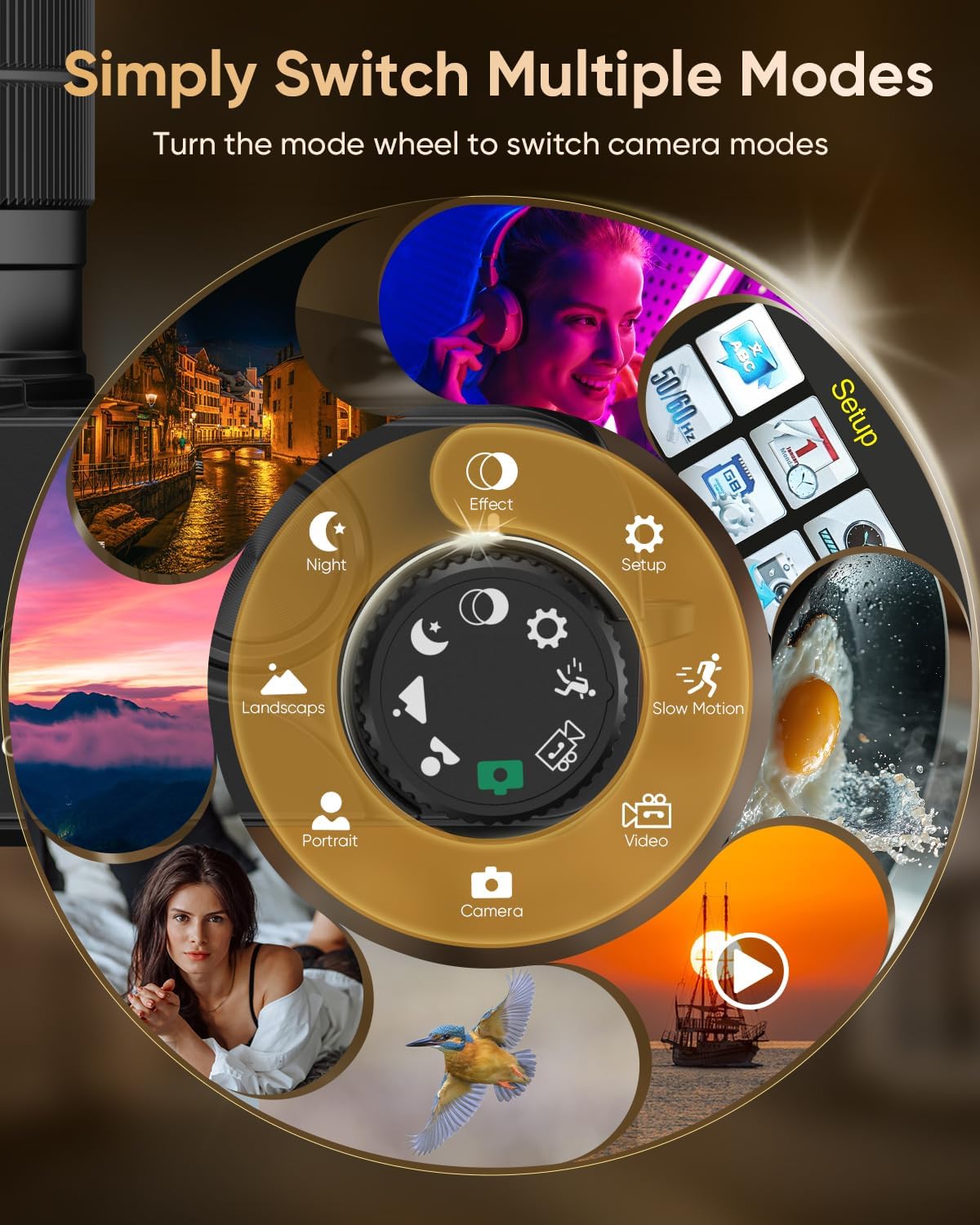
For the traveling creator, bulk is the enemy. Unlike interchangeable lens systems that require a dedicated bag, this point-and-shoot form factor is designed to slip into a jacket pocket or a small daypack. The inclusion of a Top Dial is a significant ergonomic win. In a market segment often cluttered with deep menu systems navigated via rear buttons, a physical mode dial offers immediate, tactile access to core functions—Photo, Video, Slow Motion, and Filters. This “one-button mode switching” philosophy lowers the barrier to entry for beginners who may find touchscreen-only interfaces frustrating or slow when trying to capture a fleeting moment. It reinforces the camera’s identity as a tool for shooting, rather than a gadget for configuring.
The Vlogger’s Viewfinder: The 180° Flip Screen
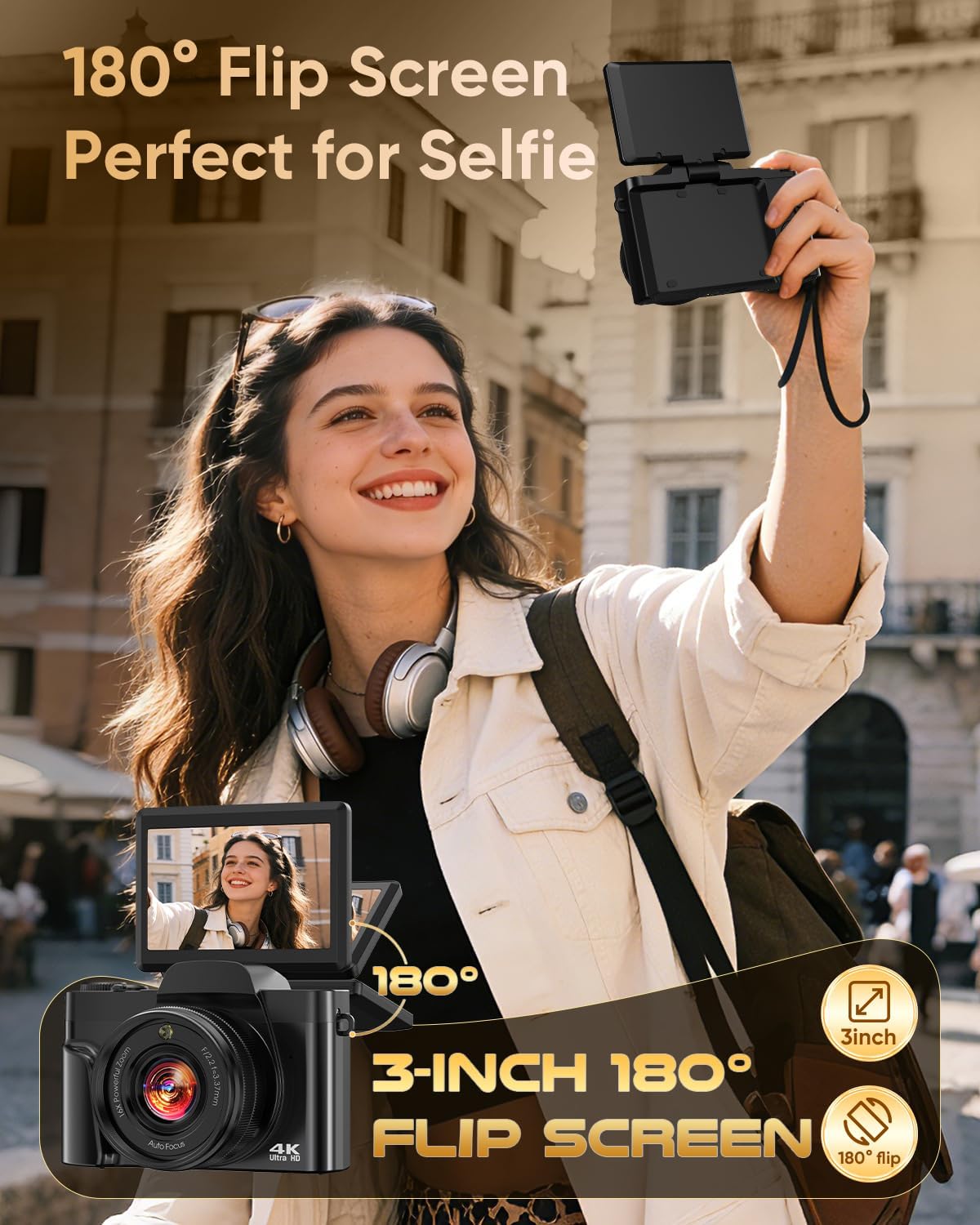
If there is a single feature that defines this camera’s target demographic, it is the 180° Flip Screen. The product description explicitly labels this as “an ideal vlogging digital camera for vloggers and selfies,” and the utility is undeniable.
For solo content creators, the inability to see oneself while recording is a fundamental flaw of traditional fixed-screen cameras. This flip mechanism solves that instantly. Whether held at arm’s length for a walking-and-talking segment, mounted on a mini tripod for a sit-down tutorial, or flipped up for a high-angle crowd shot, the articulation provides compositional confidence. It transforms the camera from a “point-and-hope” device into a precise framing tool. The description notes it helps capture “unforgettable moments anytime and anywhere—whether you’re traveling, competing, partying, or celebrating graduations,” highlighting the social versatility this screen unlocks. For the beginner, this visual feedback loop is critical for learning composition, exposure, and focus behavior in real-time.
Imaging Core: 64MP Stills and 4K UHD Video
At the heart of the device lies an advanced CMOS sensor capable of outputting 64MP photographs and 4K UHD video. It is important to contextualize these numbers for the prospective buyer. In this class of camera, high megapixel counts are often achieved through pixel binning or interpolation from a smaller physical sensor size compared to APS-C or Full Frame mirrorless systems. However, for the intended use case—social media sharing, YouTube uploads, travel documentation, and printing at standard sizes (e.g., 8×10 or A4)—the resolution headroom is more than sufficient.
The 64MP capability allows for significant cropping in post-production without catastrophic loss of detail, effectively simulating a “digital zoom” after the fact with better quality than the optical zoom alone might provide. For video, 4K UHD (3840 x 2160) has become the baseline standard for quality content. It offers four times the resolution of 1080p, allowing for crisp downscaling to 1080p timelines (providing digital zoom/pan capabilities in editing) and future-proofing archives for higher-resolution displays.
The description highlights “smooth 4K UHD video,” suggesting a competent frame rate (likely 30fps, standard for this tier), suitable for cinematic b-roll, vlogging segments, and family memories.
The Critical Differentiator: Autofocus Performance
Perhaps the most technically significant feature listed is the fast, precise Autofocus (AF). The description makes a specific claim: “Autofocus function helps you to get clear images even in moving situations or capturing static scenery. The travel camera helps beginners quickly and easily master framing skills. Even beginners can easily take sharp, beautiful pictures.”
In the budget compact camera segment, AF performance is historically the weak link—hunting in low light, pulsing during video, or locking onto the background instead of the subject. If this unit delivers on the promise of reliable phase-detection or advanced contrast-detection AF with face/eye detection (implied by the vlogging focus), it represents a massive leap in usability. For a beginner, nothing is more discouraging than a gallery full of soft, missed-focus shots. Reliable AF allows the user to trust the camera, enabling them to focus on composition and storytelling rather than technical troubleshooting. The mention of “moving situations” suggests tracking capability, essential for capturing kids, pets, or sports action during travel.
Bringing the World Closer: 16X Digital Zoom
The specification lists a 16X Digital Zoom. It is crucial to distinguish this from optical zoom. Optical zoom uses physical lens elements to magnify the image without quality loss. Digital zoom crops the sensor’s image data. However, with a 64MP sensor, the camera has a massive pixel reservoir to draw from. A 16X digital zoom on a 64MP base still leaves a usable pixel count for social media resolution (approx. 2-4MP depending on implementation), whereas on a 12MP sensor, 16X digital zoom would yield a muddy, unusable result.
The marketing copy paints a vivid picture of the use case: “Whether it’s a sweeping mountain view, a goal on the field, or an artist on stage, this 4K digital camera brings distant subjects up close with stunning clarity.” For a travel camera with a fixed lens (implied by the “point-and-shoot” and “compact” descriptors), this digital reach is a necessary compromise to maintain the slim form factor. It allows the user to “capture sharp, detailed shots and unforgettable memories without moving an inch”—a distinct advantage in crowded venues or restricted areas.
Stabilization: The Anti-Shake Factor
Hand-in-hand with zoom is the necessity for stabilization. The title and description feature Anti-Shake technology. At full 16X zoom extension, even microscopic hand tremors translate into violent frame shake. Electronic Image Stabilization (EIS) or sensor-shift stabilization (IBIS) is mandatory here. For video, smooth footage is the hallmark of professional-looking content; for stills, it allows lower shutter speeds in dim environments (indoor parties, golden hour travel shots) without motion blur. The inclusion of this feature rounds out the “travel camera” promise, ensuring that the zoom and high resolution are actually usable in handheld scenarios.
Connectivity Workflow: Built-in Wi-Fi and App Control
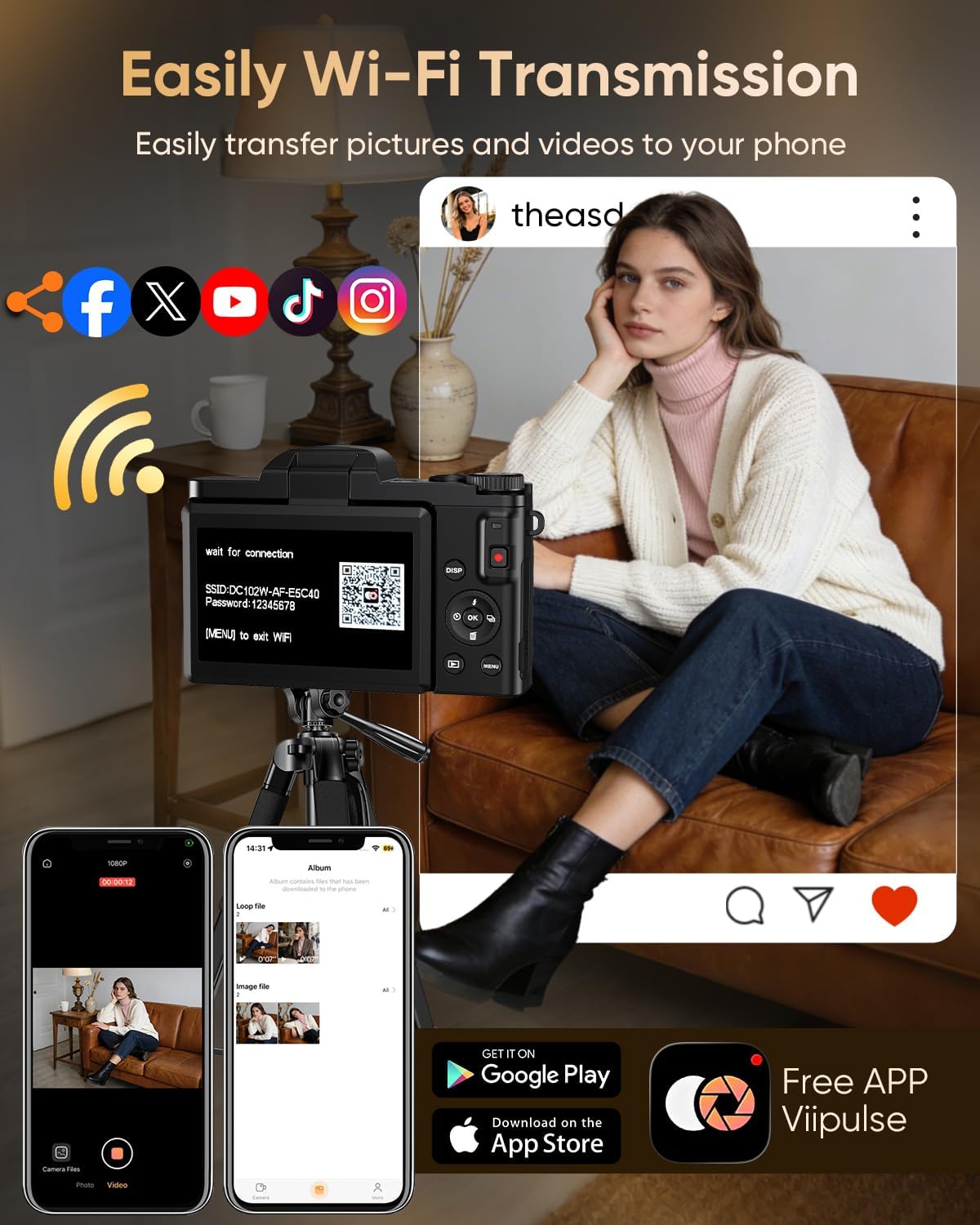
The modern creator does not live by the SD card reader alone. The Built-in Wi-Fi functionality addresses the friction point between capture and publication. The description outlines a seamless workflow: “Instantly shares your wonderful, memorable moments… quick transfer of photos and videos to your smart devices for easy editing and social media sharing.”
This is a critical feature for the “YouTube/Travel” target audience. It eliminates the need to carry a laptop or dongles for offloading footage during a trip. The companion app extends functionality further: “Use the companion app for remote 4K digital camera control and new shooting perspectives.” This enables:
- Remote Shutter: Eliminating camera shake for long exposures or group photos where the photographer wants to be in the frame.
- Live View Monitoring: Using the phone as a larger, brighter external monitor when the camera is mounted high, low, or in an awkward position.
- Instant Backup: Offloading select keepers to phone storage (or cloud) freeing up the 32GB card for continued shooting.
The “Complete Starter Kit” Value Proposition
One of the strongest selling points of this specific package is the included accessories. The industry standard for entry-level cameras is often “body only,” forcing the buyer to immediately purchase memory cards and spare batteries—often proprietary and expensive.
This bundle includes:
- 32GB Memory Card: The description notes this provides “ample storage of high-definition photos and smooth 4K videos.” While 32GB fills quickly at 4K/64MP rates (roughly 40-60 minutes of 4K video or ~1,000+ RAW/JPEG images), it allows the user to shoot immediately upon unboxing. It removes the “hidden cost” frustration.
- 2 Rechargeable Batteries: This is arguably the highest value inclusion. Compact cameras with Wi-Fi, flip screens, and 4K processing are power-hungry. A single battery rarely lasts a full day of mixed shooting. A second battery effectively doubles the operational uptime, enabling “shooting all day long” as advertised. The ability to charge one while using the other (assuming USB charging support, standard in this class) creates a near-infinite power loop for travel.
This “ready-to-shoot” philosophy aligns perfectly with the “Beginner” labeling. It reduces decision fatigue and accessory compatibility anxiety.
Creative Modes: Slow Motion and Filters
The Top Dial’s inclusion of Slow Motion and Filters modes speaks to the social-first design.
- Slow Motion: Usually implemented at 1080p/60fps or 120fps (conformed to 30fps playback), this adds production value to travel videos—capturing water splashes, hair flips, or sports impacts with dramatic effect.
- Filters: In-camera creative filters (Vintage, B&W, Sepia, Toy Camera, etc.) allow for a “shot-on-film” aesthetic or stylized looks without requiring post-processing apps. For the beginner who wants a finished look straight from camera to Instagram Story, this is a significant time-saver.
Target Audience Analysis: Who Is This For?
Based solely on the provided specifications and description, the ideal user profile emerges clearly:
- The Aspiring Vlogger/YouTuber: Needs 4K, flip screen, mic input (not explicitly listed, but onboard audio is standard), Wi-Fi for fast turnaround, and lightweight gear for “walk-and-talk” mobility.
- The Travel Enthusiast: Prioritizes compact size, durability, zoom reach for landmarks, anti-shake for low-light cityscapes, and the dual-battery/32GB kit for days away from power outlets.
- The “Smartphone Graduate”: A user frustrated by the lack of physical controls, zoom quality, and battery drain on their phone. The Top Dial and dedicated shutter button offer a tactile photography experience that a touchscreen cannot replicate.
- The Gift Buyer/Graduate: The “Complete Starter Kit” packaging (Camera + Card + 2 Batteries) makes this a zero-friction gift for birthdays, graduations, or holidays.
Potential Considerations (Inferred from Specs)
While the feature list is robust, a discerning buyer should weigh inherent trade-offs in this category:
- Low Light Performance: Small sensors (implied by compact size/zoom ratio) and variable apertures typical of this class struggle in dim light compared to larger sensor cameras. The “Anti-Shake” and high ISO noise reduction will be working overtime at night.
- Audio: No external microphone jack is mentioned in the provided text. Onboard stereo mics are standard but susceptible to wind noise and handling noise—critical for vlogging. A “deadcat” wind muff for the camera body might be a necessary secondary purchase.
- Digital Zoom Limits: As noted, 16X is digital. Quality at the extreme end will not match optical zoom cameras (bridge cameras), though the 64MP sensor mitigates this better than most.
- Build Material: “Lightweight and durable” often implies polycarbonate plastic construction. It handles well but lacks the weather-sealing or metal chassis of premium compacts.
Final Verdict: A Compelling Entry Point
The 4K Digital Camera WiFi 180° Flip Screen Autofocus 64MP 16X Zoom presents a remarkably cohesive package for its intended market segment. It does not pretend to be a professional cinema camera or a low-light monster. Instead, it executes ruthlessly on the “Vlogging/Travel/Beginner” brief.
The combination of a vari-angle screen (essential for self-shooting), reliable Autofocus (essential for keeper rates), 4K/64MP resolution (essential for modern quality standards), and Wi-Fi/App control (essential for modern workflow) hits every major checkbox for a 2024/2025 content creator.
The decision to bundle a 32GB card and two batteries transforms this from a “camera body purchase” into a “solution purchase.” It respects the user’s time and budget, allowing them to charge the batteries, insert the card, flip the screen, and start creating within minutes of opening the box.
For the beginner looking to elevate their visual storytelling beyond the smartphone, the traveler needing a lightweight zoom companion, or the vlogger seeking a dedicated B-camera or primary A-camera without the complexity of interchangeable lenses, this black compact camera stands out as a highly capable, thoughtfully configured creative tool. It proves that “entry-level” no longer has to mean “feature-poor.”